

A curated Christmas collection workflow that actually works
The workflow that produces a genuinely cohesive, giftable Christmas collection runs in seven stages: researching last season’s data, set a theme and price ladder, vet suppliers against a kill list, prototype packaging, price in tiers, build a production calendar, then launch with clear fulfilment promises. Skip any one of these and you end up with a collection that looks like a random pile of stock rather than a considered gift narrative.
Here is the micro checklist to start today, before you read another word:
- Pull last year’s sales data and flag your highest margin, lowest return SKUs as your starting shortlist.
- Choose one theme and one recipient profile (newborn, baby shower, or child aged 2 to 6) rather than trying to serve everyone at once.
- Draft a kill list of suppliers or products with lead times longer than three weeks from now.
- Decide your presentation tier now, not later, because packaging decisions affect your pricing maths.
- Set a personalisation cut-off date and mark it in red on your calendar.
For newborn and baby-shower ranges specifically, reusable embroidered fabric wrap tends to outperform single-use paper as the presentation layer. It photographs beautifully, it survives the inevitable unwrapping chaos at a baby shower, and it becomes a keepsake the parents keep rather than bin. That single decision does more to lift perceived value than almost anything else in the collection.
Key takeaways
A repeatable curated Christmas collection workflow depends on early sourcing, a strict kill list, tiered pricing, and packaging that turns personalisation into perceived value.
| Point | Details |
|---|---|
| Start sourcing 8 to 12 weeks out | Confirm suppliers and apply your kill list before prototyping packaging or pricing. |
| Cap the range deliberately | Ten to fifteen well-chosen newborn or baby-shower SKUs outsell a sprawling catalogue. |
| Price in three tiers | Good, better, best bundles lift average order value without eroding trust. |
| Build in embroidery buffer time | Personalisation lead times need their own cut-off, published clearly to shoppers. |
| Choose reusable fabric wrap for keepsake gifts | Embroidered wrap raises perceived value and avoids the paper-in-the-bin problem entirely. |
Table of Contents
- What does success look like for a curated Christmas collection?
- What is the step-by-step workflow for curating a holiday collection?
- How do you source and vet suppliers for a curated collection?
- How should you package and present Christmas gifts?
- How does reusable embroidered wrap fit into a newborn gift bundle?
- How do you price and bundle a curated collection?
- What does an 8 to 12 week production calendar look like?
- What templates make this workflow repeatable?
- How do you measure results and improve next season?
- A curator’s honest take on trade-offs
- Frequently asked questions
- Sources
What does success look like for a curated Christmas collection?
Success is not just “it sold out.” A well-run collection lifts average order value, protects margin, keeps returns low, arrives on time, and leaves the recipient with something they actually wanted to receive. For newborn and baby-shower gifting specifically, satisfaction has an extra dimension: the gift needs to feel considered rather than grabbed off a shelf on the way to the hospital.
The outcomes worth designing towards are:
- Average order value uplift through bundling, not just discounting.
- Margin preservation by filtering out low-margin filler SKUs before they make the shortlist.
- Low return rate, particularly important with personalised or embroidered goods that cannot be resold once monogrammed.
- On-time delivery, which matters more in a six-week Christmas window than at any other point in the retail calendar.
- Recipient delight, measured through repeat purchase and word of mouth rather than guesswork.
Success metrics to track: aim for a bundle attach rate that beats your single-item baseline, a return rate that stays meaningfully below your general catalogue average, and on-time fulfilment that holds steady even during peak week. Shopify’s own guidance on building a holiday gift guide recommends filtering for high-margin, low-return products from the outset specifically because post-holiday logistics problems erode profit fast when returns spike in January.
Personalisation earns its place here because it does double duty. Caroo’s curation documentation notes that selection criteria for genuinely well-curated gifts include perceived value, fulfilment reliability, and giftability rather than raw popularity, and an embroidered name or birth date ticks all three: it feels premium, it is hard to source elsewhere, and it gives the giver a reason to choose your collection over a generic list.
What is the step-by-step workflow for curating a holiday collection?
The workflow moves through seven checkpoints, each with a minimum deliverable before you progress to the next.
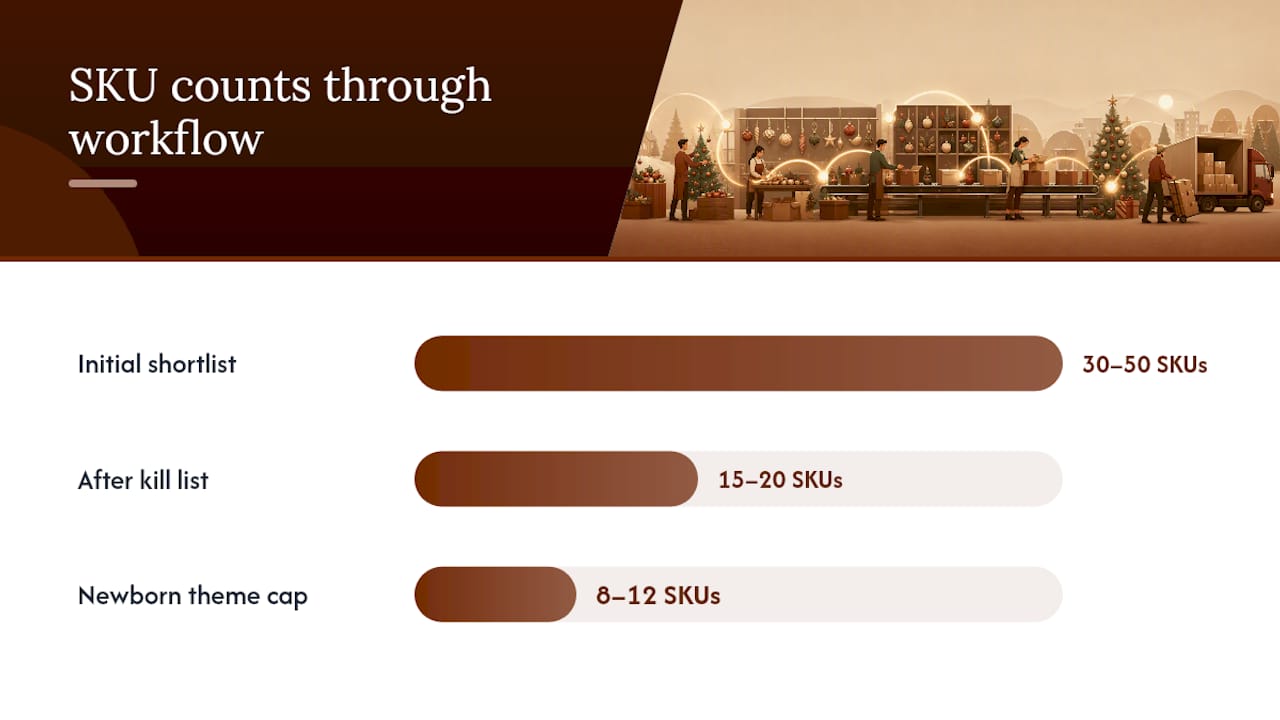
- Research and observe. Study last year’s sales, note recipient gaps (newborn, sibling, grandparent gifts), and start a running pinboard. A five-step gifting framework worth borrowing recommends observing recipient cues early, filtering ideas, deciding, executing, and delivering, which maps neatly onto a retail curation cycle. Deliverable: a shortlist of 30 to 50 candidate products or ideas.
- Set the theme and recipient profile. Pick one dominant narrative, whether that’s “first Christmas” newborn gifts or a baby-shower capsule, and resist the urge to cover every occasion at once. Deliverable: a one-line brief you could hand to a photographer.
- Apply the kill list. Remove any product with unreliable supply, poor reviews, or a lead time that threatens your launch date. Deliverable: a shortlist trimmed to 15 to 20 confirmed SKUs.
- Prototype packaging and personalisation. Test your wrap, tags, and card copy on two or three hero items before committing across the range. Deliverable: one finished sample bundle, photographed.
- Price the tiers. Build good, better, best pricing so shoppers can trade up without feeling stretched. Deliverable: a pricing sheet with margin per tier.
- Build the production calendar. Work backwards from your last safe shipping date, allowing extra days for embroidery and hand-finishing. Deliverable: a week-by-week calendar (covered in full further down).
- Launch and fulfil. Go live with clear delivery promises, then monitor stock and returns daily during peak weeks. Deliverable: a live collection page with a stated cut-off date for personalised orders.
A quick decision tree keeps scope sane: if your theme is newborn gifting, cap the range at 8 to 12 SKUs across three price tiers; if it’s a broader kids’ range, you can stretch to 15 to 20 SKUs but should still hold three tiers rather than a scattergun of prices. Fewer, better-chosen items nearly always outsell a sprawling catalogue at Christmas.
Pro Tip: Prioritise items with genuinely short lead times and high perceived value over items that are merely cheap to produce. A £28 embroidered wrap that ships in four days will outsell a £45 gadget that ships in three weeks, every single time, once your cut-off date arrives.
How do you source and vet suppliers for a curated collection?
Sourcing failures are the single most common reason curated collections collapse in December. A vendor questionnaire, run early, catches most of them before they become a crisis.
Ask every supplier:
- What is your current lead time, and does it change after the last week of November?
- What is your minimum order quantity, and can it flex if I need a top-up run?
- What is your returns policy on personalised or made-to-order goods?
- Can you drop-ship, or must I hold stock?
- What packaging options do you offer, and are they recyclable or reusable?
- What is your guaranteed UK shipping window during peak season?
Fulfilment reliability, brand reputation, and giftability matter more than novelty when you are choosing between two similar products, a principle Caroo’s team applies consistently when curating gift options for corporate and personal collections. Shopify’s guidance goes further, recommending you actively build a kill list of products with poor reviews or unreliable supply and remove them before you build your guide, rather than discovering the problem in week two of December.
Once you have your questionnaire answers, sort suppliers into three columns: confirmed and safe, confirmed but watch closely, and excluded. That excluded column is your kill list. Anything with a lead time beyond your safe cut-off, however lovely the product, belongs there.
How should you package and present Christmas gifts?
Presentation is where a collection either reads as considered or reads as thrown together, and the gap between the two is often a few pounds of packaging spend, not a different product.
Four presentation routes suit most curated collections:
- Single-item box, clean and affordable, best for entry-tier products.
- Tiered gift bundle, several small items grouped by theme, ideal for baby-shower sets.
- Reusable fabric wrap with embroidery, the strongest option for newborn and keepsake gifting because the wrap itself becomes part of the gift rather than waste.
- Small add-ons, a handwritten note, a ribbon, a sprig of something seasonal, which lift perceived value at minimal cost.
| Presentation option | Approximate cost impact | Perceived value |
|---|---|---|
| Single-item box | Low | Modest |
| Tiered gift bundle | Moderate | Good |
| Reusable embroidered fabric wrap | Moderate | High, and repeatable use adds lasting value |
| Small add-ons (note, ribbon, sprig) | Low | Small lift, best combined with another option |
Personalisation is what turns any of these from “nice” into “kept.” Luxury gifting research consistently finds that a personal touch, whether that’s an embroidered name or a handwritten note, is what transforms a commodity into a keepsake and nowhere is that truer than at a baby shower, where the gift often outlives its original wrapping by years.
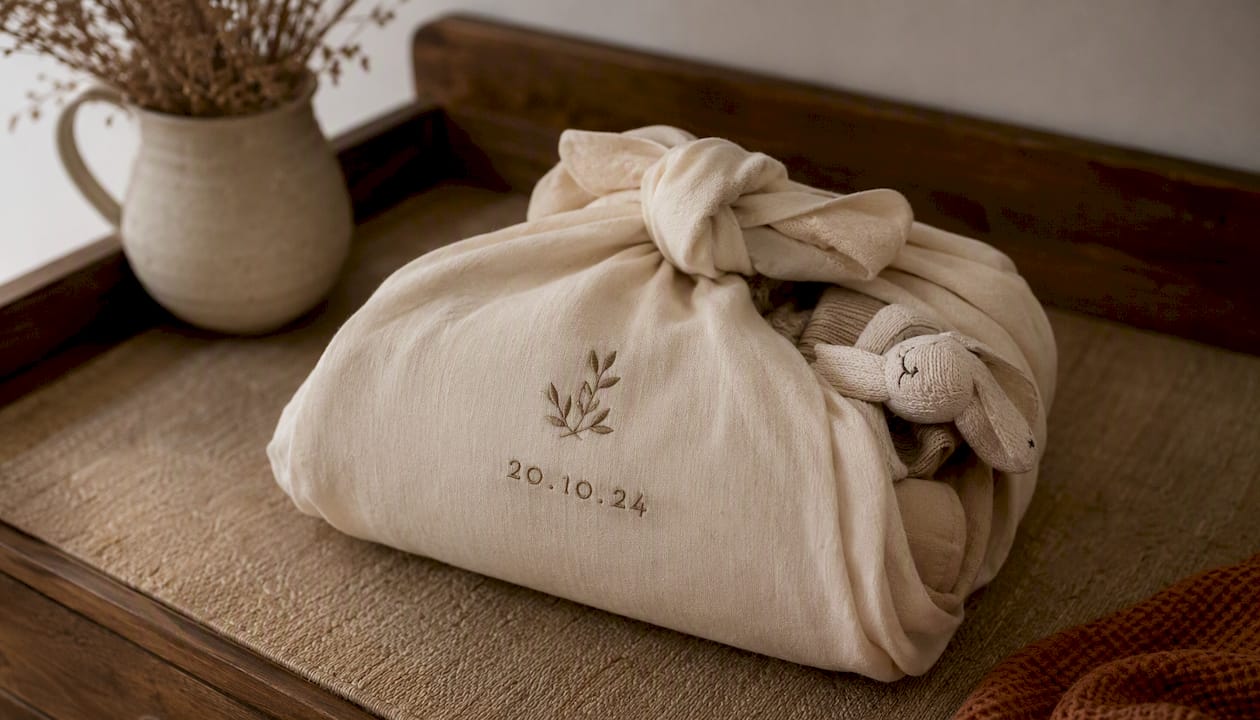
Pro Tip: If you’re choosing between spending your presentation budget on a fancier box or on embroidery, choose embroidery. A name and date on fabric wrap gets photographed, shared, and remembered in a way a printed box rarely does.
How does reusable embroidered wrap fit into a newborn gift bundle?
Consider the maths on a typical newborn bundle. Single-use wrapping paper, ribbon, and a gift tag might cost you 90 pence to £1.20 per gift, all of which goes in the bin, often before the baby even arrives home from hospital. Reusable embroidered fabric wrap costs more upfront, but it replaces itself as a keepsake the parents fold away and reuse, which shifts the entire cost conversation from “consumable” to “component of the gift.” Shoppers routinely pay a premium for that shift, particularly when the embroidery carries the baby’s name or birth date.
Packing a newborn bundle with fabric wrap in practice looks like this:
- Lay the wrap flat and centre the folded item (a blanket, sleepsuit, or small toy) in the middle third.
- Fold the two side panels inward, then the top and bottom, using the traditional furoshiki-style wrap rather than tape.
- Tie with the attached ribbon or a coordinating cord rather than a knot that damages the fabric.
- Attach a personalised tag with the baby’s name, date, or a short message, positioned so it’s visible without unwrapping.
- Photograph the finished bundle flat and at an angle before dispatch, so your product listing shows the embroidery clearly.
Fulfilment on personalised embroidered goods needs its own rules. Build in a realistic lead time for the embroidery run itself, separate from standard dispatch, and state clearly that personalised items are non-returnable except for manufacturing faults. That single line of policy, stated upfront, prevents most disputes before they start. You can see the full presentation approach in Nicholas & Rose’s guide to luxury holiday gift presentation, which walks through the wrap-and-tie process in more detail.
How do you price and bundle a curated collection?
Pricing a curated collection well means resisting the urge to price everything individually and hoping shoppers add extras. Bundling deliberately, with a clear “good, better, best” ladder, does more for average order value than almost any other single decision in the workflow.
A simple worked example: if your cost on a wrap, a small toy, and a card comes to £9, a straightforward two-times markup gives a recommended retail price around £18 to £20 for the single item. Bundle three related items with a personalised wrap and price the set at roughly 15% to 20% below what the items would cost bought separately, and you both lift order value and give the shopper a visible reason to trade up.
| Tier | Typical contents | Suggested positioning |
|---|---|---|
| Good | One hero item, simple wrap | Entry point, low commitment |
| Better | Two to three items, embroidered wrap, tag | Most popular tier, best margin balance |
| Best | Full bundle, embroidered wrap, personalised note, keepsake box | Premium gift, highest perceived value |
Set your free-shipping threshold just above your “better” tier price, not your “good” tier, so shoppers are nudged to add one more item rather than abandoning the basket. And keep your bundle discount modest. A discount that looks too generous makes shoppers suspicious of the individual item pricing, which undermines trust in the whole collection.
What does an 8 to 12 week production calendar look like?
Editorial gift guides at major publications start curating months ahead of launch, often running shared pinboards for months before final selection. A smaller curated collection can move faster, but 8 to 12 weeks from first sourcing call to launch day is a realistic minimum once you account for embroidery lead times.
| Weeks to launch | Milestone | Owner |
|---|---|---|
| Week 12 | Theme confirmed, supplier questionnaire sent | Curator |
| Week 10 | Kill list applied, shortlist confirmed at 15 to 20 SKUs | Curator / buyer |
| Week 8 | Packaging prototype and embroidery sample approved | Design |
| Week 6 | Pricing tiers finalised, product photography booked | Curator / marketing |
| Week 4 | Collection page built, personalisation cut-off date published | Marketing |
| Week 2 | Launch, marketing cadence begins | Marketing |
| — | Personalisation orders close for guaranteed Christmas delivery | Fulfilment |
Build in contingency from week eight onward. Keep two or three backup SKUs on standby in case a supplier misses a deadline, and have a gift-card or voucher fallback ready to advertise if a specific bundle sells out early. The tightest constraint in the whole calendar is embroidery lead time. Personalised fabric wrap needs its own buffer separate from standard dispatch, and that cut-off date should be published prominently on your site well before peak week, not discovered by a panicked shopper on 20 December.
What templates make this workflow repeatable?
A handful of simple templates turn this from a one-off scramble into something you can run every year with minor adjustments.
- Vendor questionnaire: the six questions from the sourcing section, kept in a single spreadsheet tab per supplier.
- SKU selection grid: columns for product, cost, lead time, margin, and kill-list status, sorted so risky items surface immediately.
- Packing checklist: a repeatable list matching the newborn bundle steps above, laminated if you’re packing by hand at volume.
- Card copy snippets: short, warm lines ready to adapt, such as “Wrapped with love, made to be kept” for a newborn tag, or “A little something for the newest arrival” for a baby-shower card.
- Product description template: a fill-in-the-blank paragraph covering material, personalisation option, and care instructions, so listings stay consistent across the range.
Here’s how each slots into the workflow:
- Run the vendor questionnaire during week 12, before anything else.
- Populate the SKU selection grid as answers come in, and apply your kill list directly in that same sheet.
- Draft card copy and product descriptions during week 8, alongside your packaging prototype.
- Use the packing checklist from week 4 onward as stock arrives.
- Keep everything in one shared spreadsheet or moodboard tool. Faire’s guidance on narrative product curation recommends centralising visual assets on shared boards so product photography, social posts, and email all read as one consistent story rather than disconnected campaigns.
A short gift-finder quiz on your collection page, even a simple three-question version, also helps shoppers self-select the right bundle quickly and gives you useful first-party data on what recipients they’re buying for, a tactic Shopify highlights as effective during peak season.
How do you measure results and improve next season?
The numbers that matter most, in order, are: average order value uplift against your baseline, bundle attach rate, return rate on personalised items specifically, on-time delivery percentage, and some form of satisfaction signal, whether that’s a review score or repeat purchase rate.
A short post-season review, run within two weeks of your last shipment, keeps this workflow sharp year on year:
- List every SKU and mark it keep, adjust, or kill based on sell-through and return rate.
- Note which supplier delivered on their stated lead time and which didn’t, feeding directly back into next year’s vendor questionnaire.
- Review any customer feedback on personalisation, particularly around embroidery accuracy and turnaround time.
- Check whether your “better” tier really was the most popular, or whether shoppers gravitated to “good” or “best” instead, and adjust your pricing ladder accordingly.
Returns data deserves particular attention here. If a specific bundle attracted a disproportionate share of returns, that’s rarely a pricing problem. It’s usually a mismatch between the product photography and the actual item, or a recipient-fit issue that a wishlist or recipient-choice option could solve, an approach Caroo recommends specifically as a returns-reduction tactic for shoppers with strong personal preferences.
A curator’s honest take on trade-offs
Every curated collection comes down to trade-offs, and the biggest one I keep circling back to is value against cost. It’s tempting to chase the widest possible range, because more SKUs feel like more choice, but in practice a tight, well-edited collection of 10 to 15 items always outperforms a sprawling 40-item catalogue at Christmas. Shoppers buying for a newborn or a baby shower don’t want to compare forty options. They want three or four that feel considered, and they want the presentation to do some of the emotional work for them.
The other trade-off that catches people out is speed against personalisation. Embroidery takes time, and there’s a real temptation to shorten that lead time by rushing the finishing or cutting the cut-off date too close to Christmas Day. Don’t. A late personalised gift, or worse, a rushed one with a stitching error on a baby’s name, does more damage to trust than simply selling out early and pointing shoppers to a voucher instead.
Nicholas & Rose’s own focus, reusable fabric wrap that replaces the wrapping paper most newborn gifts end up buried under, exists precisely because of that first trade-off. A keepsake wrap costs more to produce than a roll of paper, but it earns that cost back in perceived value and in the fact that it never ends up in a bin before the baby even comes home. That’s not a marketing line. It’s the entire reason the range exists.
Frequently asked questions
What is a curated Christmas collection workflow? It’s a repeatable sequence, from research and supplier vetting through pricing, packaging, and launch, that turns a scattered product list into a cohesive, giftable seasonal range with clear fulfilment promises attached to every item.
How long does it take to curate a Christmas collection? Most well-run collections need 8 to 12 weeks from first supplier contact to launch, with extra buffer built in for personalised or embroidered items where lead times run longer than standard stock.
What makes a gift feel curated rather than random? A single theme, a tight SKU count, consistent presentation, and a personal touch such as embroidery all signal that someone thought about the recipient specifically, rather than picking items purely by price point.
Is reusable fabric wrap more expensive than paper? It costs more per gift upfront, but because it doubles as a keepsake the recipient keeps and reuses, shoppers routinely treat it as part of the gift’s value rather than a disposable expense.
How far in advance should personalised orders close for Christmas? Publish your personalisation cut-off date clearly on your collection page, allowing extra time beyond standard dispatch for the embroidery run itself, so guaranteed delivery promises hold even during peak week.
Sources
- Holiday Gift Guide: How To Create One (2025) - Shopify
- How We Curate Gift Options — Caroo (docs)
- The art of gifting — Pomp & Circumstance PR
- How to buy the perfect Christmas gift — XmasTips
If you’re ready to put reusable embroidered wrap at the centre of your newborn or baby-shower collection, Nicholas & Rose’s Baby & Beyond milestone gift wrap range is built for exactly this workflow, with personalisation options designed to become part of the keepsake rather than something that ends up in the recycling before the big day even arrives.
Recommended
- What is a curated christmas collection? eco guide – Nicholas & Rose Limited
- Why choose Christmas collections 2025: sustainable gifting – Nicholas & Rose Limited
- Curated Christmas Wrapping: Sustainable Luxury Unwrapped – Nicholas & Rose Limited
- Eco-friendly Christmas wrap: Curated, reusable family solutions – Nicholas & Rose Limited