

Embroidery personalisation ideas for baby and kids
TL;DR:
- Embroidery personalisation ideas for babies and children focus on delicate designs, choosing appropriate techniques and fabrics to create lasting keepsakes. Reusable embroidered fabric wraps offer eco-friendly, meaningful alternatives to disposable paper, becoming treasured family heirlooms over time. Simplicity, thoughtful material choices, and cohesive presentation elevate embroidered gifts into memorable, enduring gifts.
There is something quietly profound about a gift that carries a name, a date, or a tiny motif stitched with intention. When you are searching for embroidery personalisation ideas for a newborn, a baby shower, or a young child’s milestone, the options can feel both thrilling and overwhelming. Thread colour, font choice, fabric type, stitch technique — each decision shapes whether the finished piece becomes a treasured keepsake or simply a pleasant object. This article walks you through every meaningful consideration, from design selection to finishing touches, with a particular focus on reusable fabric gift wraps that replace paper destined for the bin.
Table of Contents
- Key takeaways
- What to consider when choosing embroidery personalisation ideas
- Creative embroidery personalisation ideas for newborn gifts
- Embroidery ideas for toddlers and young children
- Comparing embroidery techniques for different gifts
- Practical tips for finishing your embroidery personalisation projects
- My honest view on thoughtful embroidery personalisation
- Bespoke embroidered gift wraps for your little one’s milestones
- FAQ
Key takeaways
| Point | Details |
|---|---|
| Stitch count matters for newborns | Keep designs under 5,000 stitches on infant items to protect delicate skin and preserve fabric softness. |
| Font choice affects legibility | Sans-serif fonts read more clearly than serif fonts when embroidered text is under two inches. |
| Technique shapes the end result | Tone-on-tone, puff embroidery, and appliqué each create very different textures, so match the technique to the gift. |
| Reusable fabric wraps add lasting value | Embroidered fabric gift wrap becomes a keepsake in itself, long outlasting disposable paper. |
| Plan for production time | Custom embroidered pieces such as name bunting typically require 2 to 3 weeks to produce. |
What to consider when choosing embroidery personalisation ideas
Before you settle on a design, a few thoughtful decisions will determine whether your finished piece delights or disappoints.
Stitch density and skin safety. For anything touching a newborn, stitch density is the single most important technical consideration. Experts recommend keeping designs to fewer than 5,000 stitches on infant garments and blankets, because dense stitching creates a stiff, rough reverse side that can irritate sensitive skin. A beautifully delicate monogram will always serve a newborn better than an elaborate, thread-heavy scene.
Font and text size. When personalised embroidery designs include a name or initial, font choice makes or breaks the result. Sans-serif fonts like Arial or Helvetica maintain clean legibility at small scales, while serif fonts tend to blur and lose definition below two inches. Keep this in mind especially for gifts where the name sits small on a pocket, cuff, or corner of a wrap.
Matching motifs to the recipient.
- For nurseries with a nature theme, botanical outlines, woodland creatures, and leaf silhouettes feel cohesive and timeless.
- Geometric patterns in muted tones work beautifully in modern, minimalist nurseries.
- For toddlers, motifs tied to a favourite animal or hobby bring personal meaning that generic designs cannot replicate.
- Neutral palettes in sage, blush, oatmeal, and soft dove grey age gracefully and suit any gender.
Fabric and stabiliser compatibility. Soft fabrics like minky and fleece require specialised stabilisers such as fusible mesh backing to anchor stitches without distorting the pile. On a reusable fabric gift wrap, the stabiliser choice also affects how the wrap drapes and folds, so it is worth discussing this with your embroiderer.
Pro Tip: Ask your embroiderer to send a stitch-out sample on a scrap of matching fabric before committing to a full run. This simple step catches font sizing issues and colour imbalances before they appear on your finished gift.
Creative embroidery personalisation ideas for newborn gifts
The newborn stage calls for restraint and refinement. The most enduring designs are often the simplest.
Minimalist monograms. A single initial in a beautiful font, stitched in a tonal thread that whispers rather than shouts, is timeless. Tone-on-tone embroidery uses thread shades that are close to but not identical to the base fabric, creating depth through subtle shadow rather than contrast. On a cream muslin wrap or a dove-grey blanket, this technique produces a result that feels genuinely bespoke.
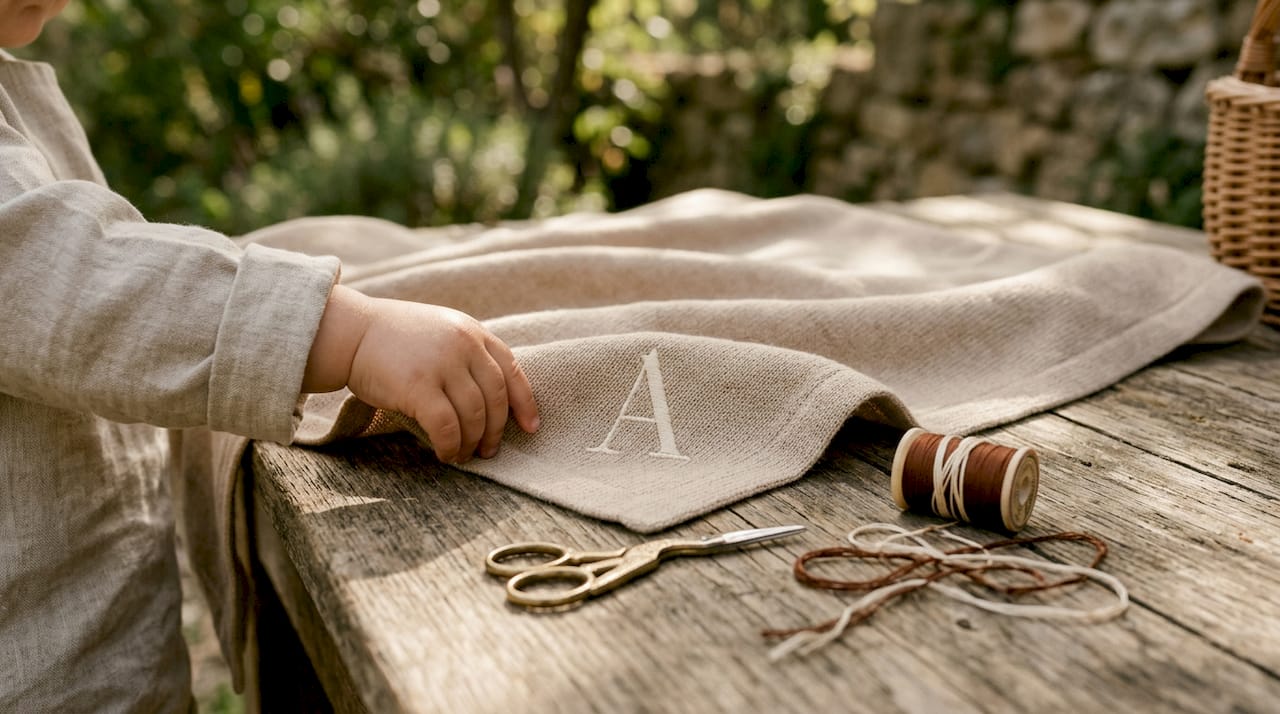
Themed motifs for nursery keepsakes. Think beyond the obvious. A tiny hot air balloon, a sprig of lavender, a single star, or a hand-drawn moon stitched in continuous line style adds personality without overpowering the fabric. Continuous line embroidery, where a design is completed in one unbroken thread path, gives a light, illustrative quality that suits newborn aesthetics beautifully.
Designs for functional newborn items. Some of the most appreciated embroidery personalisation ideas appear on objects that get daily use.
- Hooded towels with a name stitched across the hood become a bath-time ritual and a cherished photograph prop.
- Burp cloths with a simple initial or birth date feel special without the stitch density that might cause discomfort.
- Swaddle blankets with a small motif in one corner are used constantly for months and remembered for years.
Personalised name bunting as nursery decor. Embroidered name bunting is one of those gift ideas that reads as both practical and deeply personal. It goes straight onto the nursery wall and stays there, often through toddlerhood and beyond. Bear in mind that personalised bunting typically carries a two to three week production window, so order well ahead of the due date.
Pro Tip: For a truly cohesive gift, match the thread colour of your chosen motif to the fabric wrapping it. When the embroidered gift wrap and the embroidered item inside share the same palette, the presentation becomes part of the gift itself.
Embroidery ideas for toddlers and young children
Toddlers live boldly. Their gifts should too.
Where newborn embroidery tends toward the delicate and quiet, personalised embroidery designs for toddlers and young children can afford to be bolder, brighter, and more characterful. The design brief shifts from serene to playful, and the technique choices follow accordingly.
Bold palettes and graphic motifs. At this age, children are beginning to form genuine attachments to specific animals, vehicles, or characters. A child who loves dinosaurs will be genuinely thrilled by a roaring Stegosaurus stitched in emerald and gold on their tote bag. A child who loves the sea deserves a wave or a lighthouse, not a generic star. The specificity is what makes it memorable. Adjusting floss strand count allows for fine detail work in facial features or bolder, fuller coverage on larger background shapes, giving you real creative control over the final appearance.
Creative uses on accessories and fabric gift wraps. Custom embroidery projects shine on items toddlers actually carry and wear. Embroidered hats, backpacks, and tote bags are used daily, meaning the personalisation is seen again and again rather than hidden away. Reusable fabric gift wrap with a child’s name or motif stitched into it does double duty: it wraps the gift beautifully on the day, then becomes a storage bag, a doll’s blanket, or a play cloth.
- Puff embroidery, which uses foam padding beneath the stitching to create a raised three-dimensional effect, is particularly appealing to young children who love to run their fingers over tactile surfaces.
- Appliqué combines fabric shapes with embroidered edges, allowing for large, colourful motifs that would be prohibitively stitch-heavy if worked entirely in thread.
- Both techniques hold up well to washing when applied correctly, making them well suited to the rigours of toddler life.
Pro Tip: For toddler items that will be washed frequently, choose polyester threads over cotton. Polyester retains its colour through repeated washing cycles and resists the slight fading that cotton threads can show after regular machine washes.
Comparing embroidery techniques for different gifts
Choosing the right technique is as important as choosing the right design. Here is how the main options compare for baby and children’s gifts.
| Technique | Best for | Texture and look | Durability | Comfort on skin |
|---|---|---|---|---|
| Tone-on-tone | Newborn wraps, luxury blankets | Subtle, refined depth | High | Excellent |
| Puff embroidery | Toddler hats, bags | Bold, three-dimensional | Medium | Moderate |
| Appliqué | Kids’ clothing, tote bags | Graphic, colourful | High | Good |
| Continuous line | Nursery decor, wraps | Illustrative, light | Medium | Excellent |
| Satin stitch monogram | All ages, towels, wraps | Classic, smooth | High | Good |
A few additional points worth knowing as you plan your custom embroidery projects:
- Tone-on-tone works beautifully on woven fabrics like cotton canvas but loses its subtlety on heavily textured surfaces where the thread blends into the pile rather than catching the light.
- Puff embroidery requires a skilled hand to trim the foam cleanly. Poorly finished puff work can peel at the edges after washing.
- Appliqué allows for large, bold designs without the high stitch counts that would make a fabric stiff and uncomfortable, which is why it is a particularly clever choice for infant items where stitch density is a concern.
- Digitizing costs for custom designs vary significantly by size and complexity. Simple left-chest designs cost considerably less to digitise than full jacket-back artwork, so factor this into your planning if you are commissioning original artwork.
Practical tips for finishing your embroidery personalisation projects
The quality of a personalised embroidery project is not decided at the design stage alone. How a piece is finished determines whether it endures or disappoints over time.
Stabilisers and backing for infant comfort. For anything touching a baby, the reverse of the embroidery matters as much as the front. Using fusible mesh backing such as Cloud Cover encases thread ends and prevents the scratchy underside from making contact with delicate skin. On plush fabrics like towelling or minky, a water-soluble topper placed over the surface before stitching stops the needle sinking into the pile, keeping the design clean and sharp.
Placement and sizing guidance.
- For name or monogram placement on a blanket, one corner is the classic position. It is visible when the blanket is folded, easy to embroider cleanly, and does not interfere with the softness of the main fabric.
- On fabric gift wrap, centred placement works well for bold single motifs. For a name, placing it along one edge allows it to read clearly when the wrap is tied.
- Text height of half an inch to one inch is the sweet spot for most small personalised items. Below half an inch, even sans-serif fonts can lose definition.
Pairing embroidered gifts with embroidered wrapping. This is where embroidery personalisation ideas become genuinely memorable presentations. When the gift inside and the wrap around it share a design language, a colour family, or even the same single initial, the whole package becomes a considered, cohesive gesture. You can explore personalising gift wrap with embroidered fabric for a detailed guide on achieving exactly this effect.
Pro Tip: Always press embroidered fabric from the reverse, using a thick towel beneath the piece. This protects the stitching from being crushed flat and preserves the texture and dimension of your design.
My honest view on thoughtful embroidery personalisation
I have worked with embroidered fabric gifts for long enough to know that the most meaningful pieces are rarely the most complicated ones. Early on, I was drawn to elaborate designs: dense floral wreaths, multi-coloured scenes, intricate lettering. The finished pieces were technically impressive. But the gifts that people actually kept, that ended up framed or folded carefully in a keepsake box, were always the simple ones. A single initial on a soft wrap. A tiny swallow stitched in pale gold on a cream cloth.
What I have learned about fabric choice took longer to appreciate. Soft fabrics are not just a comfort consideration. They are a preservation consideration. A gift embroidered onto a fabric with a gentle drape and a smooth reverse is a gift that someone will pick up and handle again and again. A stiff, heavily stitched piece gets admired once and put away.
The reusable fabric gift wrap idea changed how I think about gifting entirely. Watching wrapping paper torn away and discarded, sometimes before everyone has even gathered in the room, always felt like a small, avoidable sadness. An embroidered fabric wrap that carries a child’s name stays in the family. It gets reused. It becomes part of the story of that child’s early years in a way that no paper could ever manage. If you are looking for the single idea that makes the most lasting impression, that is the one I would point you toward.
— Helen
Bespoke embroidered gift wraps for your little one’s milestones
Nicholasandrose has created a collection of luxury sustainable fabric gift wraps designed specifically for the moments that matter most in a child’s early life. The Baby & Beyond collection brings together beautiful, reusable wraps that can be personalised with embroidery, transforming the act of gift-giving into something lasting and eco-conscious. Each wrap is crafted from considered materials that feel wonderful in the hand and drape gracefully around any gift. Rather than paper that ends in the bin, often before the baby has arrived, these wraps become keepsakes in their own right. Explore the full range and discover how sustainable personalised gifting can be as beautiful as it is thoughtful.
FAQ
What is the maximum stitch count for newborn embroidery?
Keep embroidery on infant items to fewer than 5,000 stitches to maintain fabric softness and prevent thread density from irritating a newborn’s skin.
Which fonts work best for small embroidered names?
Sans-serif fonts such as Arial or Helvetica maintain clear legibility for embroidered text under two inches, where serif fonts tend to blur and lose definition.
What is tone-on-tone embroidery?
Tone-on-tone embroidery uses thread shades close to the base fabric colour to create subtle depth and texture, producing a refined, premium effect without visual contrast.
How long does a custom embroidered order take to produce?
Personalised embroidered items such as name bunting typically require two to three weeks of production time, so ordering well ahead of the occasion is advisable.
Can embroidered fabric gift wrap be washed and reused?
Yes. Properly finished embroidered fabric wraps, with appropriate stabilisers and quality threads, withstand repeated washing and retain their appearance for many years of reuse.
Recommended
- Personalised Embroidery Gifts Reused 5x More in 2026 – Nicholas & Rose Limited
- Embroidery gift wrap trends: sustainable personalised gifting – Nicholas & Rose Limited
- Why personalise fabric wraps for eco-conscious gifting – Nicholas & Rose Limited
- How to Personalise Gift Wrap with Embroidered Fabric – Nicholas & Rose Limited