

Embroidered Christmas wrap: luxury, eco-friendly gifting
TL;DR:
- Embroidered, reusable fabric wraps offer a sustainable and sentimental alternative to traditional Christmas wrapping, transforming gift presentation into a cherished heirloom. They reduce waste, elevate the unwrapping experience, and can be personalized with names, dates, or motifs to create lasting family keepsakes. Proper care and thoughtful design ensure these wraps can be reused for many generations, deepening the significance of holiday gifting.
There is something quietly heartbreaking about watching beautifully chosen tissue paper and glossy wrapping torn away and dropped into a bin bag, sometimes before the new baby has even had a chance to be lifted from their crib. Traditional Christmas wrapping is, by its very nature, ephemeral. Yet the gifts within are often chosen with extraordinary care, especially when they are destined for a newborn or a toddler experiencing the magic of Christmas for the very first time. This guide explores how embroidered, reusable fabric wraps offer a refined and deeply personal alternative, one that honours both the environment and the emotional weight of every gift you give.
Table of Contents
- Why choose embroidered reusable Christmas wrap?
- What you need: materials, embroidery choices, and essentials
- Step-by-step: creating and wrapping with embroidered fabric
- Caring for and reusing your embroidered wraps
- A fresh take: why heirloom gifting matters more than ever
- Ready to create cherished memories? Explore our embroidered wraps
- Frequently asked questions
Key Takeaways
| Point | Details |
|---|---|
| Reduce Christmas waste | Switching to embroidered fabric wraps cuts out single-use wrapping paper and landfill waste. |
| Personalised keepsakes | Embroidered wraps can be cherished for years, becoming memory-rich family mementos. |
| Eco-luxury gift presentation | Reusable wraps blend sustainability with beautiful design, making gifts stand out and feel special. |
| Simple care and reuse | Most embroidered wraps can be gently cleaned and used for multiple festive seasons. |
Why choose embroidered reusable Christmas wrap?
The case for reusable fabric wrapping is both practical and poetic. On a purely environmental level, the numbers are sobering. Mixed-material wrapping paper is notoriously difficult to recycle, meaning most festive wrapping ends its brief life in landfill rather than a recycling bin. Foiled papers, glittery finishes, and laminated surfaces are the principal offenders, and they are, of course, the very papers that look most beautiful under a Christmas tree. Choosing reusable fabric sidesteps this problem entirely, placing sustainability and beauty in harmonious balance.
Beyond the environmental argument, there is something profoundly different about a gift wrapped in embroidered fabric. Reusable wrapping benefits extend well past reducing waste; they transform the wrapping itself into a secondary gift, a keepsake that carries the memory of the moment long after the toy or clothing within has been outgrown.
“Fabric wrapping involves folding or knotting fabric around the gift so it can be reused, offering an enduring, tactile alternative to single-use paper.”
For families welcoming a newborn or celebrating a toddler’s first or second Christmas, this matters enormously. Imagine a soft linen wrap, embroidered with your child’s name and the year, folded away with care after Christmas morning. In ten years, that wrap still holds the scent of nostalgia, the texture of a particular winter, the story of a particular gift. Why choose sustainable wrapping becomes less a question of ethics and more a question of legacy.
Key reasons to make the switch include:
- Lasting keepsake value: An embroidered wrap bearing a child’s name or birth year becomes a treasured family heirloom rather than landfill.
- Reduced environmental impact: Reusable wraps significantly reduce the volume of non-recyclable material entering the waste stream each December.
- Tactile luxury: The drape and crisp hand-feel of quality fabric elevates the unwrapping experience for parent and child alike.
- Cost efficiency over time: A well-made fabric wrap, cared for properly, serves your family for many Christmases, making it a genuinely economical choice in the long run.
- Versatility: The same wrap can be repurposed as a decorative cloth, a keepsake pouch, or even a playful scarf as your child grows.
What you need: materials, embroidery choices, and essentials
Now that you understand the deeper purpose behind this choice, it is time to gather what you need. The foundation of a beautiful embroidered Christmas wrap is, unsurprisingly, the fabric itself. Not all materials lend themselves equally well to both wrapping and embroidery, so selecting thoughtfully at this stage makes everything that follows more rewarding.
Recommended eco fabric choices for embroidered wrapping include organic cotton, natural linen, and bamboo. Each has its own character. Organic cotton offers a gentle softness and a slightly matte finish that takes embroidery thread beautifully, with good drape for folding around curved or irregular shapes. Natural linen has a more structured hand-feel and a luminous, textured surface that elevates the visual impact of any embroidered motif placed upon it. Bamboo fabric is the most fluid of the three, exceptionally soft to the touch, making it a particularly sensitive choice for newborn gifts.
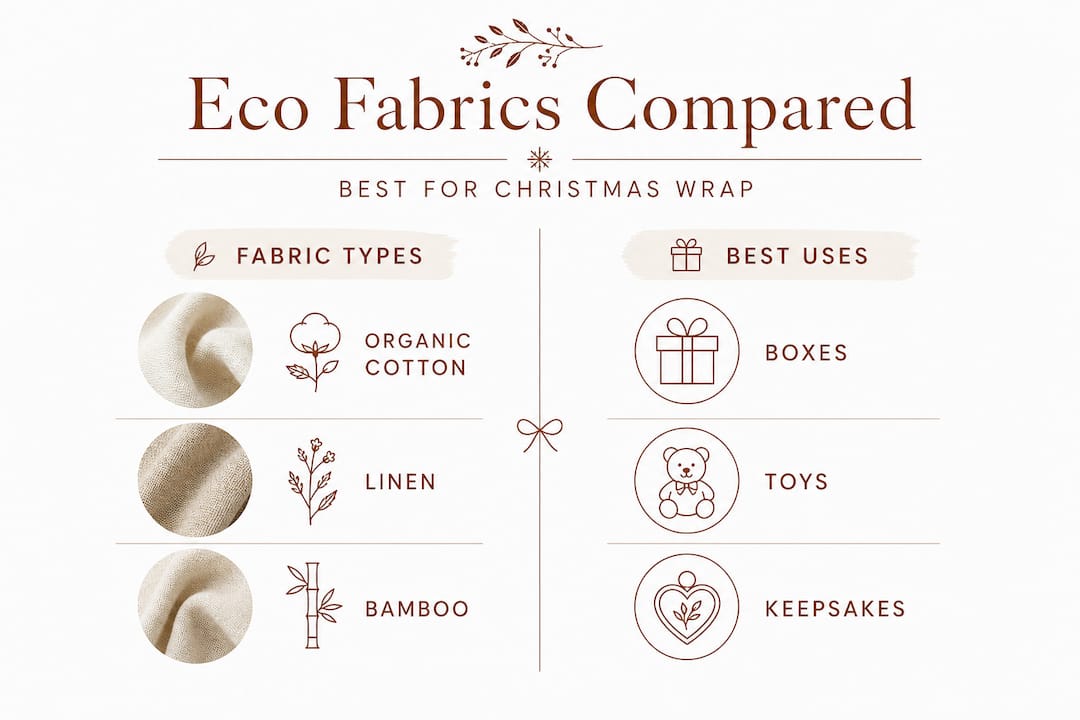
| Fabric | Best for | Embroidery suitability | Eco credentials |
|---|---|---|---|
| Organic cotton | Boxes, soft toys | Excellent | High |
| Natural linen | Structured gifts | Very good | High |
| Bamboo | Newborn gifts | Good | Very high |
| Cotton muslin | Delicate items | Good | High |
Elegant fabric ideas also extend to seasonal colourways: deep forest greens, winter whites, and dusty rose tones all create a sense of refined Christmas atmosphere without resorting to synthetic foiling or glitter.
For the embroidery itself, consider:
- Monograms: A single beautifully stitched initial in a classic serif font creates timeless elegance without crowding the fabric.
- Child’s name and year: Particularly meaningful for a first Christmas, this transforms the wrap into a dated keepsake that tells a precise story.
- Festive motifs: Delicate snowflakes, a sprig of winter berries, a small robin, or a minimalist star all complement the natural beauty of the fabric without becoming garish over time.
- Birth details: For newborn gifts, adding the date of birth alongside a tiny motif creates an extraordinarily personal wrap that functions almost as a birth announcement.
Durable, foldable fabrics paired with fabric ties rather than single-use adhesives are the recommended approach across expert wrapping guides, and this principle applies equally here. Natural cotton ribbon, jute twine, or a length of co-ordinating fabric cut on the bias all serve as beautiful, sustainable alternatives to plastic tape or synthetic bows.
Pro Tip: For newborn and toddler-sized gifts, a wrap measuring approximately 60cm x 60cm works well for small boxes and soft toys, while 90cm x 90cm accommodates larger items comfortably. Pre-wash your fabric before embroidering to account for any shrinkage, ensuring the finished piece retains its proportions across many years of seasonal use.
Step-by-step: creating and wrapping with embroidered fabric
With your materials assembled and your embroidery design chosen, the process of creating and using your wrap is more accessible than you might imagine. There is a particular pleasure in following these steps slowly, treating the whole process as what it is: a ritual of pure sophistication, not merely a practical task.
-
Pre-wash and press your fabric. Run the fabric through a gentle, cool wash before you begin embroidering. This removes any dressing or residue and ensures the piece will maintain its shape. Press with a warm iron to create a smooth, taut working surface.
-
Transfer your embroidery design. Use a water-soluble fabric pen to lightly trace your chosen motif or lettering onto the fabric. Position it thoughtfully: for wrapping purposes, a corner or central placement tends to remain visible once the gift is folded.
-
Embroider by hand or machine. Hand embroidery using a satin stitch or backstitch lends an intimate, artisanal quality that machine embroidery cannot replicate. However, machine embroidery with a high-quality digitised design offers exceptional precision and consistency, particularly for lettering. Either method, executed with care, produces a result of genuine beauty.
-
Trim and finish the edges. A folded hem stitched by hand or machine, or a pinking-shear edge for a more relaxed aesthetic, ensures the wrap does not fray with repeated use. A narrow double-folded hem in matching thread is the most refined finish.
-
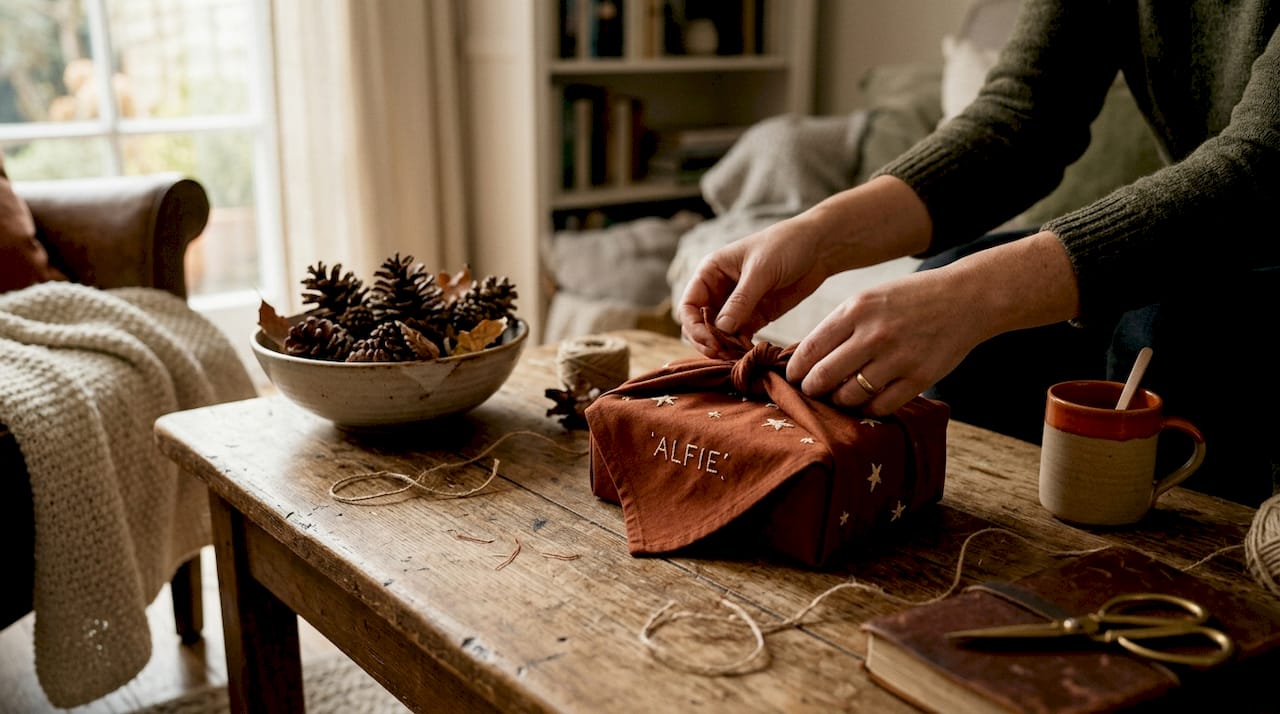
Wrap your gift using the furoshiki technique. Place your gift at the centre of the laid-flat fabric. Bring two opposite corners up and over the gift, tying them in a simple overhand knot. Bring the remaining two corners up to meet in a graceful bow. The result is a sculptural, effortlessly elegant parcel that requires no tape, no scissors, and no waste.
-
Secure with natural ribbon or fabric ties. Loop a length of cotton ribbon or jute twine around the finished wrap and tie in a generous bow. Tuck a sprig of dried lavender or a cinnamon stick beneath the bow for a sensory flourish.
| Wrapping technique | Best gift shape | Eco credentials | Difficulty |
|---|---|---|---|
| Flat fold | Boxes | Excellent | Easy |
| Furoshiki knot | Soft toys, irregular | Excellent | Moderate |
| Diagonal fold | Books, flat items | Excellent | Easy |
| Double-knot carry | Bottles, tubes | Excellent | Moderate |
Fabric gift wrapping techniques reward a little practice. The first attempt may feel tentative, but by the second or third gift, the folds begin to feel instinctive and genuinely enjoyable. And when the wrapping becomes part of the gift itself, every knot tied becomes a small act of love.
Pro Tip: Reuse fabric wrap in creative ways between Christmases: use it as a drawer liner for your child’s keepsake box, a backdrop for a birthday display, or a swaddle for a favourite toy. The more contexts in which the wrap appears, the richer its story becomes.
Caring for and reusing your embroidered wraps
After Christmas morning has given way to the quiet calm of Boxing Day, the true promise of reusable wrapping begins. Good care at this stage ensures that the wrap retains both its structural beauty and its embroidered detail across many years of family celebrations.
“The enduring appeal of fabric wrapping lies in its reusability, the ability to fold, knot, and present again and again, each time carrying a little more meaning than the last.”
Caring well for embroidered wraps involves:
- Gentle washing: Hand wash in cool water with a mild detergent, or use a machine’s delicate cycle in a mesh laundry bag. Avoid biological detergents, which can weaken embroidery threads over time.
- Stain treatment: Address any stains promptly using a small amount of gentle liquid soap applied directly before washing. Avoid rubbing, which can distort the embroidered stitching; instead, press gently with a clean cloth.
- Drying and pressing: Lay flat to dry in a well-ventilated space away from direct sunlight, which can fade both fabric and thread. Press from the reverse side, placing a thin cloth between the iron and the embroidery to protect the stitching.
- Folding and storage: Fold along the same lines each time, then store in a breathable cotton bag or a cedar-lined drawer to deter moths and preserve the fabric’s freshness.
- Annual documentation: Consider adding a small embroidered date or initial each year, turning the wrap into a growing record of Christmases shared. A wrap that has accumulated several years of tiny stitched additions becomes, in time, genuinely extraordinary.
Connecting with reusable family wrap traditions means thinking generationally. A wrap made for a newborn’s first Christmas might, in twenty or thirty years, be brought out for that same person’s child. The embroidery will have softened slightly with many washes, the fabric will carry the beautiful patina of use, and the story it tells will have grown immeasurably richer.
A fresh take: why heirloom gifting matters more than ever
There is a temptation, when sustainable gifting becomes fashionable, to approach it as a trend to be adopted rather than a value to be lived. We see it in the rush to buy whatever wrap is most aesthetically pleasing in a given season, chosen for its Instagram appeal rather than its durability or depth of meaning. This is where we respectfully offer a different perspective.
The wraps that endure, in both physical and emotional terms, are the ones chosen with the long view in mind. An embroidered fabric wrap created for a newborn’s first Christmas is not a seasonal accessory. It is, in the fullest sense, an heirloom in the making. The eco-luxury gifting philosophy we believe in is rooted in this understanding: true luxury is not extravagance, it is intention.
Parents who select embroidered wraps for their newborns and toddlers are making a quiet declaration about what they value. They are saying that the presentation of a gift is not a throwaway moment but a considered act. They are investing in objects that will be held, remembered, and passed forward. This is a reshaping of what Christmas gifting can look like, not through grand gestures, but through the accumulation of small, beautiful, intentional choices made year after year.
The pitfall to avoid is choosing novelty over sentiment. A wrap that delights purely because of a seasonal motif may feel dated by the following December. A wrap bearing a child’s name, stitched in a timeless thread colour on a natural fabric, never dates. It only deepens.
Ready to create cherished memories? Explore our embroidered wraps
If this vision of thoughtful, enduring gifting resonates with you, we would love to introduce you to our 2026 newborn and toddler collection at Nicholas & Rose. Each piece in our range is crafted from the finest natural fabrics, designed to wrap beautifully and embroider even more so.
Our bespoke embroidered wraps are available with a choice of personalised motifs, names, dates, and seasonal designs, created to become the keepsakes you and your family will return to each Christmas. Whether you are welcoming a new arrival or celebrating a toddler’s second Christmas with growing wonder in their eyes, our collection offers the perfect union of eco-conscious values and refined, heirloom-quality beauty. Browse our full range and begin your own family tradition this year.
Frequently asked questions
What fabric is best for embroidered Christmas wrap?
Organic cotton, natural linen, and bamboo are most recommended, as they are durable and foldable and accept embroidery thread with excellent results. Each fabric brings its own character, from linen’s luminous texture to bamboo’s exceptional softness for newborn gifts.
How do you secure gifts with reusable embroidered fabric wrap?
Use fabric ties, natural cotton ribbon, or knotted fabric fasteners rather than tape or plastic adhesives, which damage the fabric and defeat the eco-friendly purpose. A simple furoshiki knot or a generous bow in jute twine creates a beautiful, sustainable finish.
Can embroidered Christmas wraps be machine washed and reused?
Most embroidered fabric wraps can be gently machine washed on a delicate cycle using a mesh bag, then laid flat to dry and pressed from the reverse to protect the embroidery. With proper care, a quality wrap will remain beautiful for many years and many Christmases.
How can I personalise an embroidered wrap for my child?
Add a child’s name, birth year, or a meaningful motif such as a small star or winter robin in embroidery to transform the wrap into a lasting family keepsake. Each year you use it, the wrap accumulates another layer of shared memory.
Why are reusable wraps better for the environment than paper?
Fabric wraps keep waste out of landfill and avoid the significant recycling problems caused by mixed-material wrapping paper, making them a far more sustainable choice for families who care about their environmental impact. Each reuse multiplies the benefit, compounding year on year into a genuinely meaningful difference.
Recommended
- Luxury Christmas Wrapping Tutorial for Eco-Conscious Gifts – Nicholas & Rose Limited
- Reusable Holiday Wrap: Eco-Luxury Gifting Explained – Nicholas & Rose Limited
- Custom Embroidery Gift Wrap: Luxury With Impact – Nicholas & Rose Limited
- Luxury Eco Christmas Wrapping Tutorial with Fabric Gifts – Nicholas & Rose Limited