

How to wrap oddly shaped gifts sustainably with fabric
TL;DR:
- Fabric wrapping offers a beautiful, reusable alternative that molds easily around irregularly shaped gifts for young children. It reduces waste, doubles as a keepsake, and transforms gift-giving into a mindful, meaningful act. With simple tools and techniques like furoshiki, anyone can craft elegant, eco-friendly wraps that carry lasting sentimental value.
There is something quietly defeating about standing at the wrapping table with a soft toy giraffe, a wooden push-along, or a bulging hamper of baby essentials, a roll of paper in hand, and the creeping sense that no amount of folding will make this look elegant. Traditional wrapping paper, for all its festive charm, was never designed for the curious contours of newborn and toddler gifts. Worse still, that paper is destined for the recycling bin, often torn apart within seconds by small, impatient hands. Fabric wrapping offers a genuinely beautiful, reusable alternative that rises to the challenge of every awkward angle, and this guide will walk you through exactly how to make it work.
Table of Contents
- Why fabric wraps are best for awkward gifts
- What you need: Tools and materials for eco-friendly wrapping
- Step-by-step: Wrapping an oddly shaped gift using furoshiki
- Troubleshooting and alternative tips for tricky presents
- The overlooked value of fabric wraps in modern gifting
- Sustainable gift wrap options and inspiration
- Frequently asked questions
Key Takeaways
| Point | Details |
|---|---|
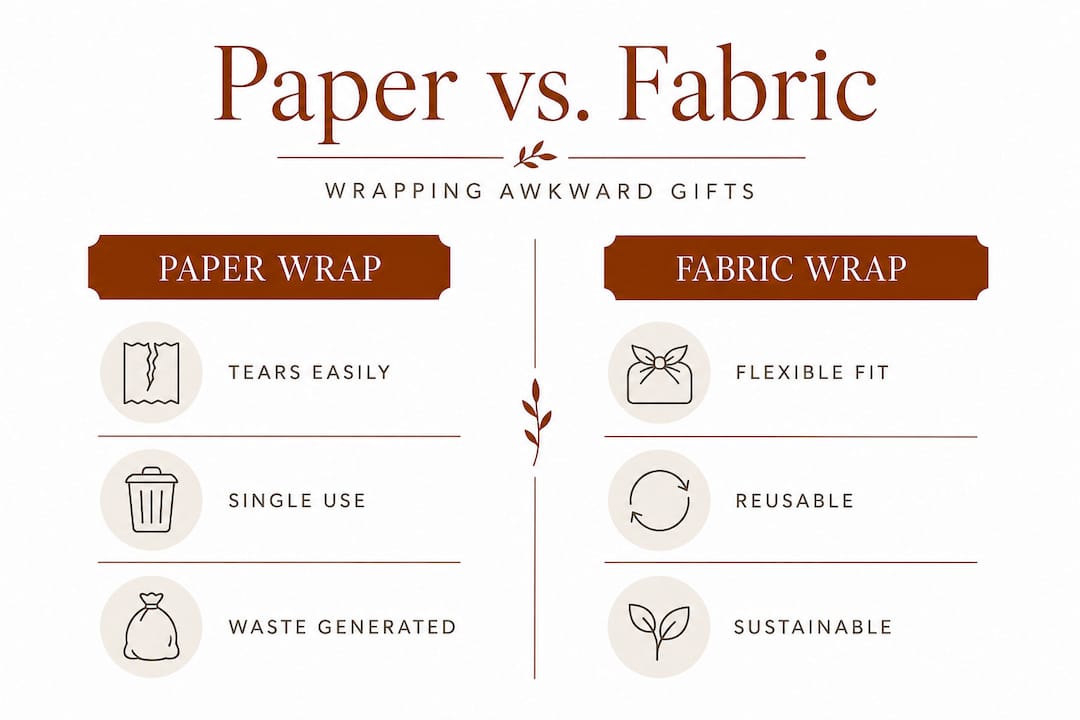
| Fabric is more flexible | Flexible cloth wraps easily mould around awkward and complex gifts, preventing tears and waste. |
| Sustainability matters | Reusable fabric cuts landfill waste and can be repurposed year-round for multiple celebrations. |
| Furoshiki pouch is secure | The pouch wrapping method holds even loose or irregular gifts safely with no need for tape. |
| Make the wrap part of the gift | Choose fabrics babies and toddlers can play with or wear, adding lasting value to your present. |
| Creative solutions for bulk | Large or odd-shaped gifts can be wrapped with bigger fabric panels or simple tablecloths for an attractive, waste-free finish. |
Why fabric wraps are best for awkward gifts
The moment you place an oddly shaped present at the centre of a beautifully chosen piece of fabric, something shifts. Where paper would buckle, crease, and require a small fortune in tape to hold together, fabric simply drapes. It moulds itself around soft toy limbs, curves over baby bath sets, and folds gracefully across the corners of board book collections. This is not mere aesthetics. It is the practical genius of a material that bends with you rather than against you.
Fabric-based wrapping reduces waste for newborn and toddler gifting because the cloth wrap can function as part of the present itself, whether that means a muslin cloth, a lightweight scarf, or a reusable storage pouch, and it is designed to be reused rather than discarded after a single unwrapping. This is the core reason eco-conscious parents and thoughtful gift-givers are turning to elegant fabric solutions with such enthusiasm. The wrap becomes a secondary gift in its own right.
Country Living’s experts advise that you should use flexible materials such as fabric rather than rigid paper for awkward or oddly shaped gifts, precisely because these materials can flex and mould around the object’s form. This practical wisdom, born from experience with the most challenging of Christmas presents, applies just as readily to a plush bunny or a nesting cup set as it does to a novelty wine bottle.
When comparing fabric to paper for these gifts, the difference becomes clear:
| Feature | Fabric wrap | Traditional paper |
|---|---|---|
| Adapts to unusual shapes | Yes, drapes naturally | No, tears and buckles |
| Reusable | Yes, indefinitely | No, single use |
| Doubles as a gift | Yes (muslin, scarf, cloth) | No |
| Safe for small children | Yes, soft and pliable | Edges can be sharp |
| Eco credentials | Excellent | Poor to moderate |
| Visual elegance | Refined and tactile | Variable, often crumpled |
The fabrics that work best for this purpose include:
- Organic cotton: Soft, breathable, and washable, ideal for gifts intended for newborns
- Linen: Crisp hand-feel with a natural drape that folds beautifully and ages gracefully
- Upcycled cloth: Old muslins, scarves, or lengths of vintage fabric carry a nostalgic warmth
- Lightweight canvas: Excellent for heavier gifts that need a little more structure
- Jersey knit: Stretches gently around rounded toys or plush items without losing its shape
Explore the range of reusable fabric gift wrap options available for newborns and toddlers to find the weight and weave that suits your gift perfectly.
Pro Tip: Choose a print or colour palette that speaks to the personality of the nursery or the parents’ own aesthetic. A wrap in soft sage, warm oatmeal, or a delicate floral print will feel considered and personal long before it is ever opened.
What you need: Tools and materials for eco-friendly wrapping
One of the most liberating realisations about fabric wrapping is how little you actually need. There is no requirement for scissors, tape, or metres of curling ribbon. The method is intentionally simple, which makes it both accessible for first-time eco-gifters and genuinely pleasurable to practise.
The furoshiki tradition, rooted in Japanese cloth-wrapping culture, demonstrates this beautifully. Furoshiki wrapping is reusable and typically avoids tape, ribbon, and scissors entirely, making it particularly well-suited to irregular shapes. The knot itself becomes the embellishment, neat and purposeful, requiring nothing but the cloth and your hands.
Here is what you will want to gather before you begin:
- Your chosen fabric: Sized generously enough to wrap the gift with at least 20 to 30 centimetres of excess on each side for tying
- Natural twine or fabric ribbon (optional): For an extra flourish or to secure a particularly unwieldy shape
- A handwritten tag or personalised card: To carry your message and the recipient’s name
- Dried botanicals or a sprig of greenery (optional): Tucked into the knot for a nature-inspired finishing touch
- An embroidered fabric wrap: For the most meaningful and lasting impression, a personalised piece transforms the wrapping into a keepsake
| Material | Best for | Sustainability rating |
|---|---|---|
| Organic cotton muslin | Newborn gifts, soft toys | Excellent |
| Linen | Book sets, wooden toys | Excellent |
| Upcycled scarf or cloth | Sentimental, artisan gifts | Outstanding |
| Jersey knit | Rounded or plush items | Very good |
| Natural twine | Tying, decoration | Very good |
The art of personalised eco-friendly wrapping adds a layer of intention to your gift that paper simply cannot replicate. When a wrap carries an embroidered name or birth date, it becomes an heirloom in miniature, passed down through celebrations rather than discarded after the first.
Step-by-step: Wrapping an oddly shaped gift using furoshiki
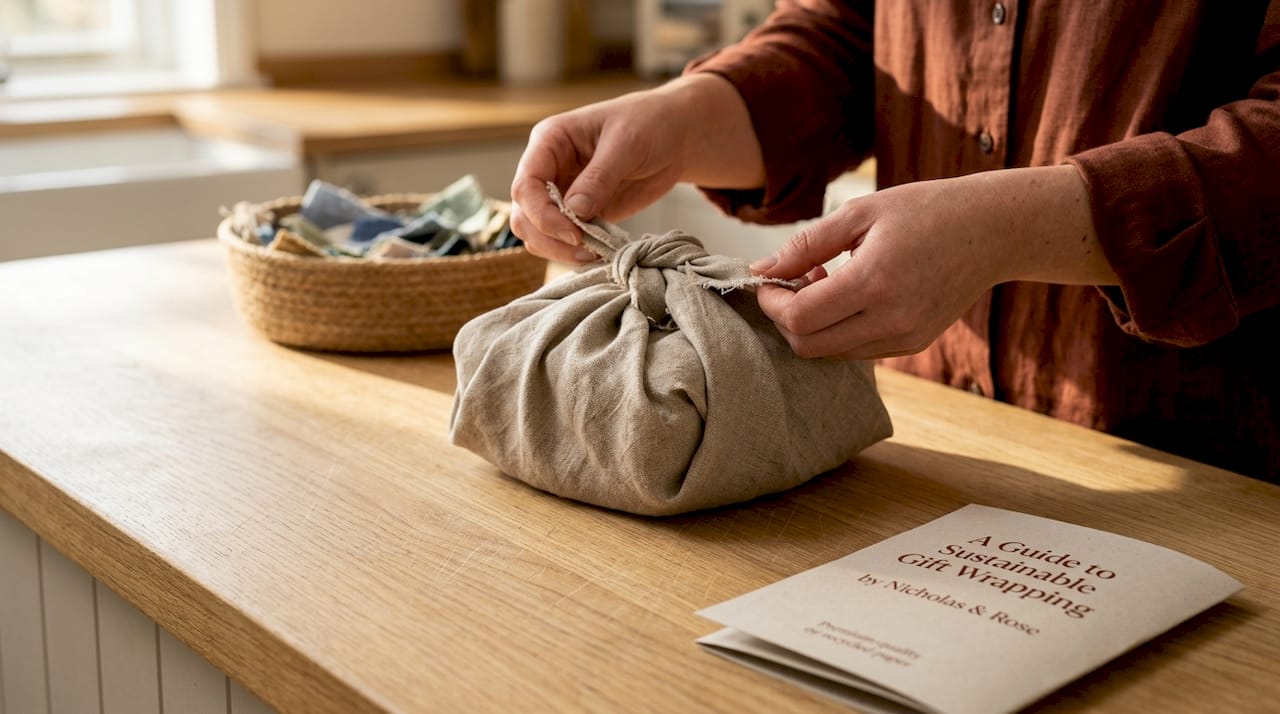
The furoshiki pouch method, known in Japan as Yotsu Musubi, which translates loosely as “four-corner tie,” is the technique best suited to the unpredictable silhouettes of baby and toddler gifts. Follow these steps with patience and you will achieve a result that looks as though it has been crafted rather than merely wrapped.
- Lay your fabric flat: Spread the cloth on a clean, smooth surface, ideally with the decorative or embroidered side facing downward.
- Position the gift in the centre: Place your item at the heart of the fabric, angling it slightly on the diagonal if it has a pronounced length, as this gives you more fabric to work with at the corners.
- Bring two opposite corners together: Lift the first corner and draw it up and over the gift, then bring the opposite corner up and over to meet it. Tie these two corners together in a firm half knot close to the surface of the gift.
- Gather the remaining two corners: Take the third and fourth corners, lifting them upward so that the fabric hugs the contours of the gift snugly beneath.
- Tie to complete the pouch: Bring these two remaining corners together over the first knot and tie them into a bow or a secure double knot, adjusting the gathers as you go so the fabric sits evenly.
- Adjust and sculpt: Gently pull the fabric taut at each side, tucking in any loose areas and reshaping the knot until the overall effect is balanced and refined.
For loose or oddly shaped items, the furoshiki pouch method (Yotsu Musubi) works by placing items in the centre and tying adjacent corners to form a secure pouch, with the volume and shape adjusted as needed. This adaptability is what makes it so well-suited to the irregular gifts that characterise early childhood celebrations.
You can find more detailed premium fabric wrapping instructions and visual guides to help you master the folds, as well as a range of fabric folding techniques for more complex gift shapes.
Pro Tip: For gifts intended for babies under twelve months, opt for a firm double knot rather than a decorative bow. Little hands will tug and pull at the wrapping with enormous enthusiasm, and a secure knot ensures the gift stays beautifully intact until a parent can assist with the reveal.
A gentle note on safety: When wrapping gifts for children under two years of age, avoid incorporating loose ribbons, beads, buttons, or any small embellishments into the wrapping. A simple, well-tied knot in a soft fabric is both the safest and the most elegant choice. Beauty and safety are not in conflict here. They are the same thing.
Troubleshooting and alternative tips for tricky presents
Even with the most accommodating of fabrics, some gifts resist neat wrapping. A large play gym, a multi-piece wooden puzzle set, or an oversized plush elephant can all test the patience of the most practised eco-gifter. The solution is almost always to think more generously, not more precisely.
When wrapping bulky or oddly shaped gifts, a large and flexible base material, much like a tablecloth, is easier to work with than attempting to join smaller pieces together. This principle translates directly to fabric: a larger square of cloth will always give you more scope to work with than a smaller one that requires improvised extensions. If your fabric feels too small for the gift, trust that instinct and reach for something more generous.
Here are practical approaches for the most challenging of scenarios:
- Very large or bulky gifts: Use a tablecloth-sized square of fabric, or consider a lightweight cotton bed sheet in a beautiful colour. Wrap it around the gift in generous folds and tie at the top like a gathered bundle, finishing with a length of natural twine.
- Sets of multiple soft toys: Group the items together inside the fabric before tying, creating a single abundant pouch that feels like a treasure bundle rather than a collection of loose pieces.
- Slippery or particularly plush items: Line the interior of the fabric briefly with a piece of tissue paper to give the items something to grip against during the wrapping process.
- When your fabric is slightly too small: Nest the gift inside the cloth as best you can and use a complementary length of natural twine or a fabric ribbon to cinch and gather the excess, creating an intentional gathered effect at the top.
- Irregular bases or flat-bottomed gifts: Place the gift base-down in the centre of the cloth and bring all four corners up simultaneously, gathering them at the top into a beautiful topknot.
| Challenge | Paper solution | Fabric solution |
|---|---|---|
| Very bulky gift | Join multiple sheets with tape | Use tablecloth-sized cloth, gather at top |
| Multiple loose items | Individual boxes required | Bundle together in one generous pouch |
| Rounded or plush shape | Crinkles and buckles | Drapes and moulds naturally |
| Slippery surface | Tape heavily | Add inner tissue lining for grip |
| Fabric too small | Use another sheet | Cinch with twine for gathered effect |
Discover more creative personalised wrapping tips for gifts of all shapes, and explore best reusable wrap alternatives if you are considering a broader switch away from single-use materials across all your gifting occasions.
The overlooked value of fabric wraps in modern gifting
There is a conversation happening in the world of eco-conscious gifting that often remains at the surface level. It tends to focus on the environmental calculus: how many sheets of paper saved, how many rolls of tape avoided, how much waste diverted from landfill. These are worthy measurements. But they miss the deeper value that reusable fabric wrapping quietly offers to families with young children.
Consider what happens when a baby first encounters a beautifully wrapped gift in soft, embroidered cotton. The tactile experience is entirely different from the crinkle and scratch of paper. The child reaches for it instinctively, drawn by the drape and warmth of natural cloth. That cloth, once the gift is opened, does not disappear. It becomes a play cloth, a comfort square, a doll’s blanket, or a gentle keepsake folded away in a memory box. The wrap itself has a life that extends far beyond the moment of gifting.
We believe this is the quiet revolution in sustainable gifting: not just the absence of waste, but the presence of meaning. When a fabric wrap carries an embroidered name, a birth date, or a carefully chosen motif, it transforms from packaging into an object of genuine emotional significance. Parents save these pieces. They bring them out again for the next birthday, for a younger sibling’s first gift, for a moment of nostalgic reflection years later. Explore our range of sustainable festive gift wraps to see how beautifully this intention can be expressed.
And there is something profoundly hopeful about introducing children to mindful resource use from their very first celebrations. When a toddler learns that the beautiful cloth their toy arrived in is now their favourite corner of a blanket fort, they are absorbing a lesson that no school curriculum can teach quite so elegantly. Thoughtfulness towards materials is learned earliest through touch, through delight, through the experience of something being worth keeping.
Pro Tip: Begin collecting your fabric wraps after each gifting occasion, storing them by size in a dedicated drawer or basket. Over time, you will build a family treasury of cloth, each piece carrying its own memory, ready to be used again and again across birthdays, baby showers, and seasonal celebrations.
Sustainable gift wrap options and inspiration
If this article has stirred a desire to bring more beauty and intention to your next gifting occasion, we invite you to explore what is waiting for you at Nicholas and Rose.
Our 2026 Baby and Beyond range has been created specifically for newborn and toddler gifting, with each wrap crafted from soft, natural fabrics and available with personalised embroidery to make every piece a lasting memento. Whether you are celebrating a birth, a first birthday, or a toddler milestone, you will find something quietly extraordinary in our milestone gift wrap collection. Browse the full Baby and Beyond range and discover how a single, thoughtfully chosen piece of fabric can carry more love than any amount of paper ever could.
Frequently asked questions
What fabric is best for wrapping baby gifts?
Soft, natural fibres such as cotton or linen are ideal, as they are gentle on sensitive skin, easy to launder, and well-suited to reuse. Furoshiki-style wrapping in these materials avoids the need for tape or scissors entirely.
How do I keep an irregular gift secure in fabric wrap?
Use the pouch method by tying adjacent corners firmly and adjusting the fabric to fit closely around the gift’s contours. A firm double knot, rather than a loose bow, prevents slipping and keeps the presentation intact until the moment of unwrapping.
Can I wrap very large or bulky gifts without wasting lots of paper?
Yes, and the approach is simpler than it sounds. Use a large, flexible base material such as an extra-large square of fabric or a lightweight cloth rather than attempting to tape smaller sheets together, which invariably looks untidy.
Is fabric wrap safe for babies and toddlers?
Fabric wraps are safe provided you avoid loose embellishments such as ribbons, beads, or buttons around children under two. A simple knotted cloth in a soft, non-toxic fabric is both the safest and most elegant approach to gift presentation for little ones.
Can fabric wraps be reused for other purposes?
Absolutely, and this is perhaps their greatest quality. Cloth wraps can function as blankets, play cloths, muslin-style squares, or comfort items long after the gift inside has been opened, making them one of the most genuinely zero-waste wrapping choices available.
Recommended
- Create sustainable festive fabric wraps for luxurious gifts – Nicholas & Rose Limited
- How to embellish gift wraps sustainably: 2026 guide – Nicholas & Rose Limited
- Sustainable gift wrapping with fabric: save 90% waste – Nicholas & Rose Limited
- Wrapping Gifts Without Paper: Elegant Fabric Solutions – Nicholas & Rose Limited