

Tradition and Christmas gifts: what really matters
TL;DR:
- Christmas gift traditions have evolved from meaningful tokens in Roman, Celtic, and Christian customs to elaborate Victorian ceremonies and modern retail-driven practices. Today, eco-conscious families continue the tradition by prioritizing intentionality, sustainability, and ritual structure over quantity, fostering emotional connection and timeless memories. Preserving tradition with fewer, meaningful, and thoughtfully wrapped gifts helps sustain the emotional and cultural value of holiday giving in a more environmentally mindful way.
There is a quiet pressure many eco-conscious parents feel as December approaches: the sense that honouring the role of tradition in Christmas gifts means filling a room with rustling paper, towers of boxes, and the particular chaos of a baby’s first festive morning. Yet the most enduring gift traditions were never truly about quantity. They were about ritual, intention, and the warmth of being seen. This article traces where those traditions actually came from, what they do for us emotionally, and how you can preserve every precious moment of them while choosing gifts that carry meaning long after the wrapping has gone.
Table of Contents
- The roots and evolution of Christmas gift traditions
- Psychological and social functions of gift traditions at Christmas
- How eco-conscious parents can honour tradition with sustainable gifting
- Traditional gift-giving customs vs modern eco-friendly practices for babies and toddlers
- Rethinking tradition: what really sustains Christmas gift rituals for eco-conscious families
- Sustainable personalised gifting options for newborns and toddlers
- Frequently asked questions
The roots and evolution of Christmas gift traditions
To understand the role of tradition in Christmas gifts, it helps to know that the tradition itself has always been a living, shifting thing, shaped by each era’s values rather than set in stone.
The earliest seeds were sown during the Roman festival of Saturnalia, a midwinter celebration in which social hierarchies dissolved and Romans exchanged small tokens, candles, and fruit as gestures of goodwill. Celtic winter rites carried their own gifting symbolism, with mistletoe offered as a sign of peace and fertility. These were gifts weighted with meaning, chosen for what they represented rather than their monetary value.
Christianity layered new narrative onto these older customs. The Three Wise Men arriving with gold, frankincense, and myrrh gave theological grounding to gift-giving as an act of reverence and love. St Nicholas of Myra, a fourth-century bishop known for his generosity towards the poor, became the patron saint whose legend seeded the figure of Father Christmas across European cultures. These historical customs of Christmas giving were, at their heart, about care for others, not accumulation.
The Victorian era introduced the aesthetic rituals we recognise most readily today: wrapped gifts beneath a decorated tree, stockings hung by the fire, a sense of ceremony and theatre around the act of giving. This is where Christmas gift traditions began to take the form we inherit. Even then, they reflected the values of the moment, a newly prosperous middle class expressing warmth and abundance after years of austerity.
The key insight here is that traditions have always evolved to mirror what society valued most. In the same way that examples of evolving gift traditions show us across different cultures, the form changes whilst the feeling endures. Today’s eco-conscious families are not breaking tradition by gifting differently. They are continuing tradition’s oldest habit: adapting with intention.
Key moments in the evolution of Christmas gift-giving:
- Roman Saturnalia: small tokens exchanged as gestures of goodwill
- Celtic winter rites: mistletoe and greenery as symbols of peace
- Christian tradition: gifts inspired by the Three Wise Men and St Nicholas
- Victorian England: wrapped presents beneath the Christmas tree become customary
- 20th century: commercial retail transforms volume and expectation
- Today: a growing return to eco-conscious gifting choices that prioritise meaning over mass
| Era | Primary gift tradition | Dominant value |
|---|---|---|
| Roman Saturnalia | Candles, fruit, small tokens | Goodwill and equality |
| Early Christian | Symbolic gifts of reverence | Devotion and care |
| Victorian England | Wrapped gifts under a tree | Family warmth, abundance |
| Mid-20th century | Retail-driven, multiple presents | Prosperity and celebration |
| Contemporary | Sustainable, personalised, fewer | Intention and connection |
Psychological and social functions of gift traditions at Christmas
Understanding the why behind holiday gift-giving traditions reveals something quietly radical: the psychological benefits of Christmas gifting rituals come almost entirely from the ritual itself, not from the objects exchanged.
Researchers have found that holiday rituals framed as meaningful reduce perceived difficulty by 11% and increase happiness by 25% during gifting activities. This means the way you approach the act of giving, with intention, with ceremony, with your full attention, matters far more than how many items sit beneath the tree.
“Ritual stance impacts perceived difficulty and happiness in holiday activities, reinforcing emotional value beyond objects.” — Nature, 2025
Gifts at Christmas function as symbols of connection and identity. When you choose something for a newborn with care, tracing their fingers in your mind as you select it, you are participating in a deeply human act of saying: I see you. You matter to me. The cultural significance of Christmas gifts has always lived in that intention. The wrapping, the presentation, the moment of discovery: these are the ritual containers that hold the meaning.
The importance of holiday traditions is also deeply generational. Research consistently shows that shared rituals build emotional resilience in children, creating anchoring memories that return to them as adults, steady as a lighthouse in the dark. The families who give fewer gifts with greater intentionality are not diminishing tradition. They are distilling it.
What gift rituals actually do for families:
- Create a sense of belonging and continuity across generations
- Provide emotional anchors that children carry into adulthood
- Strengthen bonds through shared attention and ceremony
- Reduce anxiety around gifting by providing familiar structure
- Signal love, care, and recognition beyond words
Explore our sustainable holiday gifting tips to see how these principles translate into practical choices for your family this Christmas.
How eco-conscious parents can honour tradition with sustainable gifting
Knowing that tradition’s power lives in ritual structure rather than gift count is liberating. It means you can preserve how traditions shape Christmas gifts in your family while making choices that align with the world you want your child to grow into.
Here is how to do that with grace and intention:
-
Keep the ritual architecture intact. The timing, the phrases, the order of events: these are the bones of tradition. Place the gift under the tree on Christmas Eve. Use the same words when you give it. Light a candle. The ceremony carries the meaning, not the volume.
-
Choose fewer gifts with greater deliberateness. A single, beautifully chosen gift for a newborn or toddler, something tactile, lasting, and personal, will be remembered in photographs and stories long after a pile of plastic toys has been quietly donated. Quality over quantity is not a modern invention; it is a return to older values.
-
Personalise with care. A gift bearing a child’s name, their birth date, or a phrase chosen just for them becomes an heirloom rather than an object. This is where eco-friendly luxury gifts for families genuinely shine: the personalisation transforms something beautiful into something irreplaceable.
-
Wrap with intention, not waste. The wrapping itself is part of the ritual. Rather than paper destined for the recycling bin before the baby has even opened the gift, consider reusable fabric wrapping that can be kept, laundered, and brought out again each year. These sustainable gift wrap ideas fold meaning into the very moment of giving.
-
Weave in experience and story. Anti-materialist gift rituals from cultures around the world show us that the most enduring traditions often centre on shared experience: a story told, a candle lit together, a moment of quiet attention. These cost nothing and last a lifetime.
Pro Tip: Write a short note to accompany your baby’s first Christmas gift. Describe the morning, your feelings, what you hope for them. Tuck it inside the fabric wrapping. Years from now, that note will matter more than any toy.
Traditional gift-giving customs vs modern eco-friendly practices for babies and toddlers
The impact of tradition on gift-giving is perhaps most visible when you compare what many families still do with what eco-conscious families are increasingly choosing. For newborns and toddlers, the contrast is especially striking.
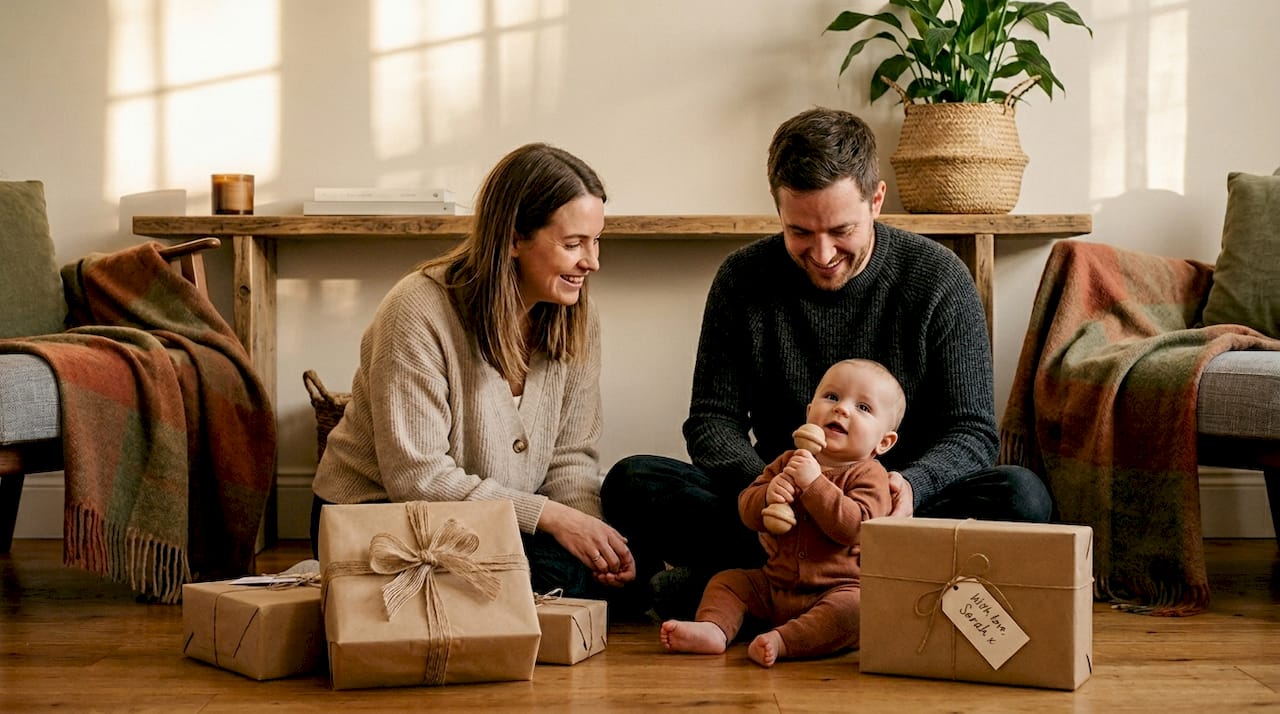
Families adopting gift frameworks that limit the number of presents or focus on need/want lists are finding that the experience of gifting becomes richer, not poorer, when the choices are fewer and more considered. The “four gifts” approach, something they want, something they need, something to wear, something to read, is one such structure that preserves the ritual whilst reducing overconsumption.
| Aspect | Traditional gifting | Eco-friendly approach |
|---|---|---|
| Number of gifts | Multiple items, often many | Fewer, deliberately chosen |
| Materials | Mixed, often plastic-heavy | Natural, durable, sustainably sourced |
| Wrapping | Single-use paper | Reusable fabric, personalised |
| Longevity | Variable, often seasonal | Designed to last and be cherished |
| Personalisation | Generic or branded | Bespoke, embroidered, memorable |
| Afterlife of wrapping | Bin, often immediately | Kept as a keepsake or reused each year |
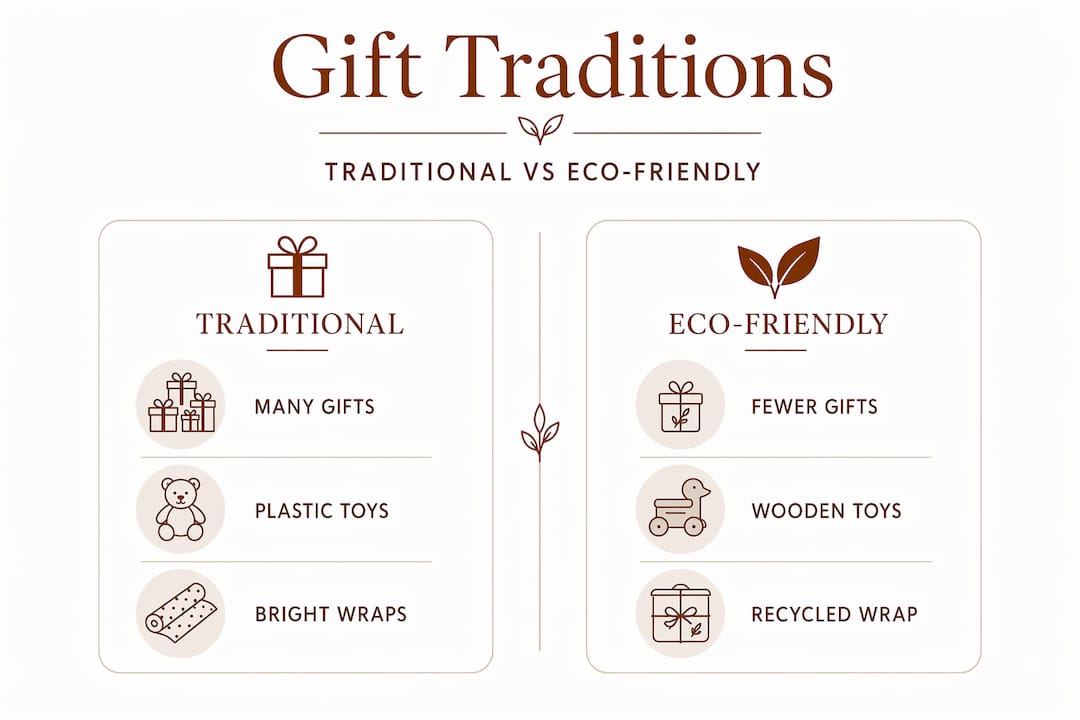
For newborns particularly, the wrapping often vanishes before the child is even conscious of the occasion. A sheet of paper discarded in moments cannot hold a memory. A piece of beautifully embroidered fabric wrap, soft and luminous, folded and stored, becomes part of the family archive.
What to consider when gifting for babies and toddlers:
- Prioritise sensory and tactile quality over novelty
- Choose items that grow with the child or serve a lasting purpose
- Opt for natural materials: organic cotton, untreated wood, undyed fabric
- Select gifts that invite adult involvement, encouraging connection
- Ensure the sustainable gift checklist for children guides your choices this year
Pro Tip: When gifting for a baby shower or a newborn’s first Christmas, the presentation often matters as much to the parents as the gift itself. A reusable fabric wrap embroidered with the baby’s name is a gift within a gift: one to unwrap, one to keep.
Rethinking tradition: what really sustains Christmas gift rituals for eco-conscious families
Here is the perspective that most gifting guides quietly avoid: tradition does not need defending from eco-consciousness. They were always meant for each other.
The psychological benefits of ritual come from consistent cues and shared attention, not from the number or type of gifts exchanged. The child who grows up remembering a particular piece of fabric wrap, brought out each year, embroidered with their name in colours chosen before they were born, is experiencing tradition at its most potent. That wrap is a repeated cue. It signals something sacred and familiar.
The modern gifting industry has convinced many of us that honouring tradition requires volume. It does not. It requires repetition, attention, and care. The families who build UK sustainable gifting innovations into their Christmas rituals are not opting out of tradition. They are opting into its original spirit.
There is also something worth naming honestly: the pressure to gift generously at Christmas is real, particularly when extended family and social expectation weigh upon new parents already navigating exhaustion and wonder in equal measure. Eco-conscious choices can feel like they require explanation or justification. They should not. A gift chosen with deep intentionality, wrapped in something beautiful and lasting, needs no apology and tells its own story with eloquence.
Tradition endures not because it is rigid but because it is emotionally true. The warmth of a gift given with full attention, the ceremony of placing something precious beneath a tree, the moment of unwrapping witnessed by people you love: none of that requires a bin bag of paper and a landfill’s worth of plastic. It requires only your presence, your care, and the quiet confidence to choose differently.
Sustainable personalised gifting options for newborns and toddlers
When you are ready to gift in a way that honours both tradition and the world your child will grow into, the choices you make for wrapping and presentation are as significant as the gifts themselves.
At Nicholas & Rose, our new 2026 newborn and toddler range brings together the warmth of personalised gifting with the elegance of reusable fabric wraps, each one embroidered with care for the specific child or occasion you have in mind. Designed to replace single-use paper that often reaches the bin before a baby’s first Christmas morning has properly begun, these wraps are heirloom pieces in their own right: soft enough to treasure, beautiful enough to display, and durable enough to be brought out again every December. Explore our luxury sustainable gift wrap for milestones, or browse our full range of sustainable baby and toddler gifts curated for longevity, intention, and joy.
Frequently asked questions
Why is the tradition of giving gifts at Christmas still important today?
Gift-giving at Christmas fulfils deep psychological needs for connection, belonging, and identity across generations, serving as a tangible expression of care that goes far beyond the exchange of objects.
How can I make Christmas gifts more sustainable for my newborn or toddler?
Focus on fewer, more meaningful gifts using eco-friendly materials and personalised touches; sustainable gift traditions preserve the ritual structure of giving whilst replacing excess with homemade, donated, or memory-based alternatives that carry lasting emotional weight.
Can I keep family gift traditions while reducing commercial pressure?
Absolutely. By centring your rituals on shared moments and ceremony rather than gift volume, you honour tradition fully; holiday traditions build closeness and emotional resilience across generations, and the ritual itself matters far more than the number of presents beneath the tree.
What are some traditional Christmas gift customs that align with eco-friendly practices?
The St Nicholas tradition of leaving small, meaningful gifts in shoes, as well as customs of handmade tokens and personalised keepsakes, align beautifully with low-waste gifting and remind us that the oldest traditions were always about thoughtfulness rather than abundance.
Recommended
- The role of tradition in luxury eco-friendly wrapping – Nicholas & Rose Limited
- Sustainable Christmas gift checklist for children 2026 – Nicholas & Rose Limited
- Top eco trends for Christmas: sustainable gifting for children – Nicholas & Rose Limited
- Eco-friendly Christmas wrap: Curated, reusable family solutions – Nicholas & Rose Limited