

How packaging reduces waste: a guide for UK gift givers
Packaging can cut total waste — including food waste — when designed and managed as part of a circular system. The single most important action you can take, whether you are a parent choosing a baby shower gift or a small business reviewing your product presentation, is to prioritise reuse and fit-for-purpose design over disposability. Packaging that protects, portions, and informs does more to prevent waste than packaging that is simply “less.”
The three most direct ways packaging reduces waste:
- Protect: barrier properties and tamper-evident seals prevent product loss across the supply chain and in the home.
- Portion: right-sized, single-serve, or resealable formats reduce the likelihood that food or product is discarded unused.
- Inform: clear date labelling and storage instructions guide consumers to use products before they spoil.
Pro Tip: When choosing gift presentation for a newborn or baby shower, ask whether the wrap itself can be kept and reused. A personalised fabric wrap functions as both packaging and a lasting memento, replacing a sheet of paper that typically reaches the bin within minutes.
Key takeaways
Packaging reduces waste most effectively when designed for reuse and fit-for-purpose protection, not simply when made from a different material.
| Point | Details |
|---|---|
| Reuse beats recyclability | A packaging format used multiple times prevents more waste than one recycled after a single use. |
| Food waste is the priority | Barrier technologies and shelf-life extension prevent food loss that carries a far greater environmental cost than the packaging itself. |
| UK EPR changes the cost equation | Producer Responsibility Obligations 2024 shift end-of-life costs to producers, making reusable and recyclable design a financial as well as environmental priority. |
| Compostable claims need infrastructure | Most compostable packaging requires industrial composting; without local collection, it contaminates recycling streams rather than reducing waste. |
| Nicholasandrose fabric wraps | Personalised reusable cotton wraps for newborns and children replace non-recyclable decorative paper across multiple gifting occasions. |
Table of Contents
- How packaging reduces food waste at every stage
- Design strategies that genuinely lower material throughput
- How do different packaging materials compare for waste reduction?
- UK policy and regulation shaping packaging waste outcomes
- How businesses can measure packaging’s contribution to reducing waste
- Practical steps consumers can take using the 5 Rs
- UK case studies and pilots that show what actually works
- Personalised reusable cotton wrap: a real-world example for newborn and kids’ gifts
- Constraints and unintended consequences worth knowing
- Verdict and practical recommendations for UK businesses and consumers
- A perspective on sustainable gifting and what it actually asks of us
- Nicholasandrose: reusable fabric gift wrap for newborns and children
- Sources
How packaging reduces food waste at every stage
The role of packaging in waste reduction is perhaps most tangible in the food system, where spoilage and loss account for a significant share of the UK’s total waste burden. Packaging intervenes at multiple points, from the farm gate to the kitchen cupboard.
Protection and barrier properties
Packaging forms a physical shield against moisture, oxygen, light, and microbial contamination. Corrugated trays protect soft fruit during transit; vacuum-sealed pouches slow oxidation in deli meats; foil laminates block UV degradation in oils and cereals. Without these barriers, retail shrinkage and household spoilage rise sharply. An integrative review of 162 studies on packaging waste management found that optimising packaging to the supply chain often prevents more environmental harm from product waste than removing packaging entirely — a counterintuitive but well-supported finding.
Shelf-life extension technologies
Modified atmosphere packaging (MAP) replaces the air inside a sealed tray with a controlled gas mixture, typically a blend of carbon dioxide and nitrogen, to slow bacterial growth. Oxygen scavengers and moisture-regulating sachets extend this further in dry goods. Active packaging — where the material itself interacts with the food environment — is now used in premium chilled ready meals and fresh produce lines across major UK retailers. A systematised review of consumer perceptions of packaging confirmed that these shelf-life functions reduce household food waste, though the same review noted that consumer acceptance depends heavily on trust in the technology and clear on-pack communication.
Portioning, resealability, and labelling
Single-serve formats reduce the risk that a larger portion goes partially used and then discarded. Resealable pouches for salad leaves, cheese, and dried goods extend the usable window once opened. Perhaps the most underappreciated mechanism is labelling: accurate “use by” and “best before” guidance, combined with storage instructions, directly shapes whether a household discards food prematurely. WRAP (the Waste and Resources Action Programme) has long advocated for clearer date labelling as one of the most cost-effective levers for reducing household food waste in the UK.
| Packaging mechanism | How it reduces waste | Example format |
|---|---|---|
| Barrier protection | Prevents spoilage from oxygen, moisture, light | Vacuum pouches, foil laminates |
| Modified atmosphere | Slows bacterial growth, extends chilled shelf life | MAP trays for fresh meat and produce |
| Resealable closure | Reduces partial-use waste after opening | Zip-lock pouches, press-seal bags |
| Portioning | Matches serving size to consumption | Single-serve pots, portion trays |
| Date and storage labelling | Guides correct use and reduces premature disposal | “Use by” and “best before” labels |
Design strategies that genuinely lower material throughput
Reducing waste through packaging is not only about what material you choose; it is equally about how the packaging is conceived from the outset. Eco-design, reuse systems, lightweighting, and standardisation each address a different point of failure in the conventional single-use model.
Eco-design principles
Eco-design starts with the question: what is the minimum packaging that reliably protects this product? Right-sizing eliminates void fill and excess layers. Materials selection for repair or reusability means choosing substrates that can be laundered, refilled, or returned rather than discarded. Designing for collection and sorting means using mono-materials or clearly labelled mixed materials that UK kerbside collection systems can actually process.
A practical eco-design checklist for businesses and gift retailers:
- Remove any packaging layer that does not serve a protection, information, or reuse function.
- Choose mono-materials (single-polymer plastics, uncoated paper) wherever possible to simplify sorting.
- Right-size packaging to the product: void fill is a cost and a waste signal.
- Label materials clearly with recycling instructions aligned to UK local authority guidance.
- For luxury gift presentation, consider whether the outer wrap can become part of the gift itself, as with embroidered fabric wraps that serve as keepsakes.
Reuse and refill systems
Closed-loop and return-and-refill models change the upstream demand for single-use materials entirely. RePack’s returnable e-commerce packaging demonstrates how circular infrastructure can reduce single-use transit packaging: customers return the packaging via post, it is cleaned and re-entered into the system, and the brand avoids purchasing new packaging for each order. Refill.org.uk’s Refill scheme operates a similar logic for consumer-facing retail, mapping refill stations across the UK so shoppers can top up household products without buying new containers each time.
Pro Tip: For baby shower and newborn gifts, a reusable fabric wrap is the gift-presentation equivalent of a refill system: the recipient keeps and reuses the wrap, so no new single-use paper is needed for the next occasion.
Standardisation and modular design
When packaging dimensions are standardised across a product range, pallets stack more efficiently, transport emissions per unit fall, and sorting facilities can process materials faster with less contamination. Modular design — where a single outer carton fits multiple inner configurations — reduces the number of distinct packaging SKUs a business must manage and reorder. For small retailers, this also simplifies EPR reporting obligations under the UK’s Producer Responsibility Obligations (Packaging and Packaging Waste) Regulations 2024.
Steps to implement standardisation in a small gift business:
- Audit your current packaging SKUs and identify where two or three sizes could replace five or six.
- Choose a standard outer dimension that accommodates your most common product range.
- Use tissue paper, fabric inserts, or reusable wraps as the variable inner element rather than bespoke boxes.
- Confirm that your standard outer material is accepted by UK kerbside collection in your primary delivery postcodes.
- Document material weights and types for EPR reporting from the outset.
How do different packaging materials compare for waste reduction?
No single material is universally superior. Each carries trade-offs across waste-reduction potential, reusability, recyclability within UK infrastructure, lifecycle greenhouse gas signals, contamination risk, and cost. Understanding these trade-offs is what separates genuine eco-friendly packaging practices from greenwash.
Lightweight plastics
Thin-film plastics and PET trays are often vilified, yet their low weight means that the carbon cost of producing and transporting them is frequently lower than heavier alternatives. More importantly, MAP and barrier films made from plastic can prevent food waste that would otherwise generate far greater environmental harm than the packaging itself. The trade-off is recyclability: flexible plastics are not collected by most UK kerbside schemes, and contamination rates in plastic recycling streams remain a persistent challenge. The Environment Agency and Defra have both flagged this infrastructure gap as a priority.
Paper and fibre-based packaging
Paper and board are widely collected and recycled in the UK, and the fibre-based sector has invested heavily in recyclable and renewable materials. Smurfit Kappa, one of the largest paper-based packaging manufacturers, publishes sustainability claims around fibre content and recyclability performance — though as with all manufacturer content, independent verification adds credibility. Paper’s weakness is moisture resistance: coatings and laminates that improve performance often compromise recyclability, and wet or contaminated paper is rejected at sorting facilities.
Glass and metal
Both are infinitely recyclable in principle and have high UK collection rates. Glass is heavy, which raises transport emissions per unit. Metal cans, particularly aluminium, have strong recycling economics and closed-loop collection in the UK. Neither is suited to flexible or decorative gift presentation.
Compostable materials
Compostable packaging carries a significant infrastructure caveat in the UK. Most compostable materials require industrial composting conditions to break down within a meaningful timeframe; home compost heaps rarely reach the temperatures needed. Biodegradable clamshell containers and similar formats are only genuinely end-of-life beneficial where industrial composting collection is available locally, which remains patchy across England, Scotland, Wales, and Northern Ireland. Placing compostable packaging in a general recycling bin typically contaminates the stream.
Reusable fabric and textile wraps
For luxury gift presentation, reusable cotton fabric wraps occupy a distinct category. Their lifecycle impact depends on reuse frequency: a wrap used once carries a higher per-use footprint than a sheet of recycled paper, but one used ten or more times across birthdays, baby showers, and seasonal gifts compares favourably. Laundering adds water and energy use, but the absence of single-use decorative paper — which is frequently non-recyclable due to foil, glitter, or laminate coatings — means the net waste avoided is real and measurable. Research on green premiums in luxury retail suggests that luxury consumers are willing to pay more for packaging with genuine reuse credentials, and that personalisation strengthens the motivation to keep and reuse rather than discard.
| Material | UK recyclability | Reuse potential | Food-safety suitability | Decorative gift use |
|---|---|---|---|---|
| Lightweight plastic film | Low (kerbside) | Low | High | Low |
| Paper and board (uncoated) | High | Low | Moderate | Moderate |
| Glass | High | Moderate | High | Low |
| Aluminium | High | Moderate | High | Low |
| Compostable (industrial) | Low without infrastructure | Low | Moderate | Moderate |
| Reusable cotton fabric | N/A (launderable) | High | Low | High |
UK policy and regulation shaping packaging waste outcomes
The regulatory environment for packaging waste management in the UK has shifted substantially since 2022, and the pace of change is accelerating. Understanding the key instruments helps businesses make design choices that reduce compliance risk as well as environmental impact.
Extended Producer Responsibility (EPR)
The Producer Responsibility Obligations (Packaging and Packaging Waste) Regulations 2024 place obligations on producers to assess the recyclability of their packaging, categorise it, and report on it. Under EPR, the cost of managing packaging waste at end of life shifts to the producer rather than the local authority. This creates a direct financial incentive to design packaging that is genuinely recyclable and to reduce material throughput. For small retailers and gift businesses, the practical implication is that packaging choices made today will affect compliance costs in future reporting periods.
Key EPR obligations for UK businesses:
- Register with a Producer Responsibility Organisation (PRO) if you handle packaging above the relevant thresholds.
- Conduct recyclability assessments for each packaging format you place on the market.
- Report packaging data annually to the Environment Agency (England) or the relevant devolved authority.
- Design new packaging with recyclability grades and reuse potential in mind, as these will affect modulated fees.
Plastics Packaging Tax
The UK Plastics Packaging Tax, administered by HMRC, applies to plastic packaging manufactured in or imported into the UK that contains less than 30% recycled content. The tax rate has been uprated in line with inflation since its introduction. It directly affects material selection decisions: businesses choosing packaging with higher recycled content, or switching to paper, glass, or reusable alternatives, can reduce or eliminate their liability. Small gift businesses importing decorative plastic packaging from outside the UK should check their import volumes against the relevant thresholds.
WRAP’s programmes, including the Courtauld Commitment and its successor frameworks, provide voluntary frameworks and measurement tools that help businesses reduce both packaging and food waste. Defra’s guidance on packaging waste sits alongside Environment Agency reporting requirements and together they form the practical compliance landscape for UK producers. Businesses that engage with WRAP’s methodology early tend to find EPR reporting less burdensome, because the data collection habits align.
How businesses can measure packaging’s contribution to reducing waste
Claiming that your packaging reduces waste is only credible when you can show the numbers. A simple measurement framework built around inputs, outputs, and outcomes gives businesses a defensible basis for reporting.
Measurement framework:
- Inputs: total packaging material weight placed on the market (by material type), number of units shipped, and packaging cost per unit.
- Outputs: packaging collected for recycling or return (by material type), reuse cycles completed per packaging unit, and product loss or damage rate during transit.
- Outcomes: food or product waste avoided (calculated from damage rate reduction), carbon savings from reuse cycles versus single-use equivalents, and EPR reporting data submitted.
| KPI | Data source | Simple calculation |
|---|---|---|
| Material throughput (kg per unit) | Procurement records | Total packaging weight ÷ units shipped × 1,000 |
| Reuse cycles per wrap | Customer return or retention data | Total reuses logged ÷ wraps in circulation |
| Product loss rate | Warehouse and returns data | Damaged units ÷ total units shipped × 100 |
| Recycling rate (by material) | PRO or local authority data | Weight collected ÷ weight placed on market × 100 |
| Food waste avoided (MAP) | Shelf-life extension data vs. control | Spoilage rate (control) minus spoilage rate (MAP) × units |
Pro Tip: When presenting waste-reduction claims to customers or in marketing, state your assumptions transparently: how many reuse cycles you assumed, what baseline you compared against, and whether figures come from internal data or a third-party lifecycle assessment. WRAP’s methodology documents provide a recognised framework for this in the UK.
For businesses using reusable fabric gift wraps, tracking reuse cycles is straightforward: ask customers to register their wrap or share reuse occasions via a simple post-purchase survey. Even a modest response rate gives you a credible average reuse figure to anchor your claims. The fabric gift wrapping workflow guidance from Nicholasandrose includes practical notes on how to communicate reuse expectations to recipients.
Practical steps consumers can take using the 5 Rs
The 5 Rs — Refuse, Reduce, Reuse, Repurpose, Recycle — translate directly into everyday choices for parents, gift buyers, and households. Applied to packaging, they form a hierarchy where the highest-impact actions come first.
- Refuse: decline unnecessary packaging at the point of purchase. Choose retailers who offer minimal or no outer packaging for online orders. When buying gifts for a baby shower or newborn, ask whether the retailer can ship without a decorative outer box.
- Reduce: buy in larger formats where appropriate to reduce packaging per unit of product. Choose concentrated cleaning products, bulk dry goods, and refillable personal care items. For gift presentation, a single well-chosen fabric wrap replaces multiple sheets of paper across several occasions.
- Reuse: choose packaging designed to be kept. A reusable cotton fabric wrap for a newborn gift becomes a muslin substitute, a toy storage pouch, or a keepsake. Refill stations, available through the Refill scheme, let you top up household products without buying new containers.
- Repurpose: glass jars become storage; tins become plant pots; fabric wraps become play mats or drawer liners. Repurposing extends the useful life of materials before they enter any waste stream.
- Recycle: as a last resort, ensure packaging goes into the correct stream. Check your local authority’s accepted materials list before placing packaging in the kerbside bin. Foil-coated or glitter-printed gift wrap is not recyclable in most UK schemes and should go in general waste rather than contaminating the paper stream.
Pro Tip: When presenting a newborn or baby shower gift wrapped in personalised fabric, include a small card explaining that the wrap is designed to be kept and reused. Recipients who understand the intention are far more likely to launder and reuse it rather than fold it away and forget it. A brief note on care — cool machine wash, line dry — is all it takes.
UK case studies and pilots that show what actually works
Evidence from UK initiatives offers a clearer picture of which packaging interventions deliver measurable reductions in waste and which fall short of their promise.
Refill scheme expansion
The Refill scheme, operated by City to Sea, has mapped thousands of refill stations across the UK, allowing consumers to top up water bottles, coffee cups, and household cleaning products without single-use containers. Participating retailers report reduced packaging waste per transaction, and the scheme has expanded from its Bristol origins to coverage across England, Scotland, Wales, and Northern Ireland. The model demonstrates that consumer behaviour changes when the infrastructure is visible and convenient.
WRAP’s Courtauld Commitment
WRAP’s Courtauld Commitment brought together UK food retailers and manufacturers to reduce food and packaging waste across the supply chain. Successive phases of the programme delivered measurable reductions in household food waste per person and in packaging weight per tonne of food sold. WRAP’s methodology, which uses a combination of retailer data, household surveys, and lifecycle modelling, provides a replicable framework that smaller businesses can adapt.
Retail packaging redesign pilots
Several UK supermarkets have trialled loose produce sections, removing pre-packaged trays and bags from fruit and vegetables. Early pilots reported reductions in plastic packaging weight per kilogram of produce sold, though some also noted increased food waste from produce without protective packaging — a reminder that removing packaging without redesigning the supply chain can shift rather than solve the problem.
Returnable e-commerce packaging
The RePack returnable packaging model has been adopted by a number of UK e-commerce brands as an alternative to single-use transit packaging. Customers receive their order in a returnable bag or box, then post it back using a pre-paid label. The packaging re-enters the system for cleaning and reuse. Brands using the model report reductions in packaging material purchased per order, though the system requires a critical mass of returns to be economically viable.
| Initiative | Intervention type | Reported outcome | Limitation noted |
|---|---|---|---|
| Refill scheme (City to Sea) | Consumer refill infrastructure | Reduced single-use container use per transaction | Dependent on consumer uptake and station proximity |
| WRAP Courtauld Commitment | Retailer and manufacturer collaboration | Reduced household food waste per person across successive phases | Voluntary; not all producers participate |
| Loose produce pilots (UK supermarkets) | Removal of pre-packaged trays | Reduced plastic packaging weight per kg of produce | Some pilots noted increased food waste without protective packaging |
| RePack returnable e-commerce | Closed-loop return packaging | Reduced single-use transit packaging per order | Requires high return rate to be viable |
Personalised reusable cotton wrap: a real-world example for newborn and kids’ gifts
Personalised reusable fabric gift wrap occupies a specific and underexplored niche in the packaging waste conversation. Most discussions of eco-friendly packaging focus on food or transit packaging; decorative gift wrapping is rarely examined, yet the UK generates substantial volumes of non-recyclable gift wrap each year, much of it foil-coated, glitter-printed, or laminated in ways that disqualify it from paper recycling streams.
A high-quality embroidered cotton wrap, such as those offered by Nicholasandrose for newborn, baby shower, and children’s gifts, functions differently from conventional wrapping paper in every respect that matters for waste reduction. It is durable enough to launder and reuse across multiple occasions. It carries personalisation — a name, a date, a motif — that gives the recipient a reason to keep it rather than discard it. And it maps directly to the 5 Rs: it refuses the single-use paper stream, reduces material throughput per gifting occasion, enables reuse across birthdays and seasonal gifts, and can be repurposed as a keepsake, a storage cloth, or a play mat long after the original gift occasion has passed.
Research on green premiums in luxury retail supports the business case: luxury consumers accept a premium for packaging with genuine reuse credentials, and personalisation strengthens the motivation to retain rather than discard. For a newborn gift, the wrap often outlasts the occasion itself, becoming part of the child’s early environment.
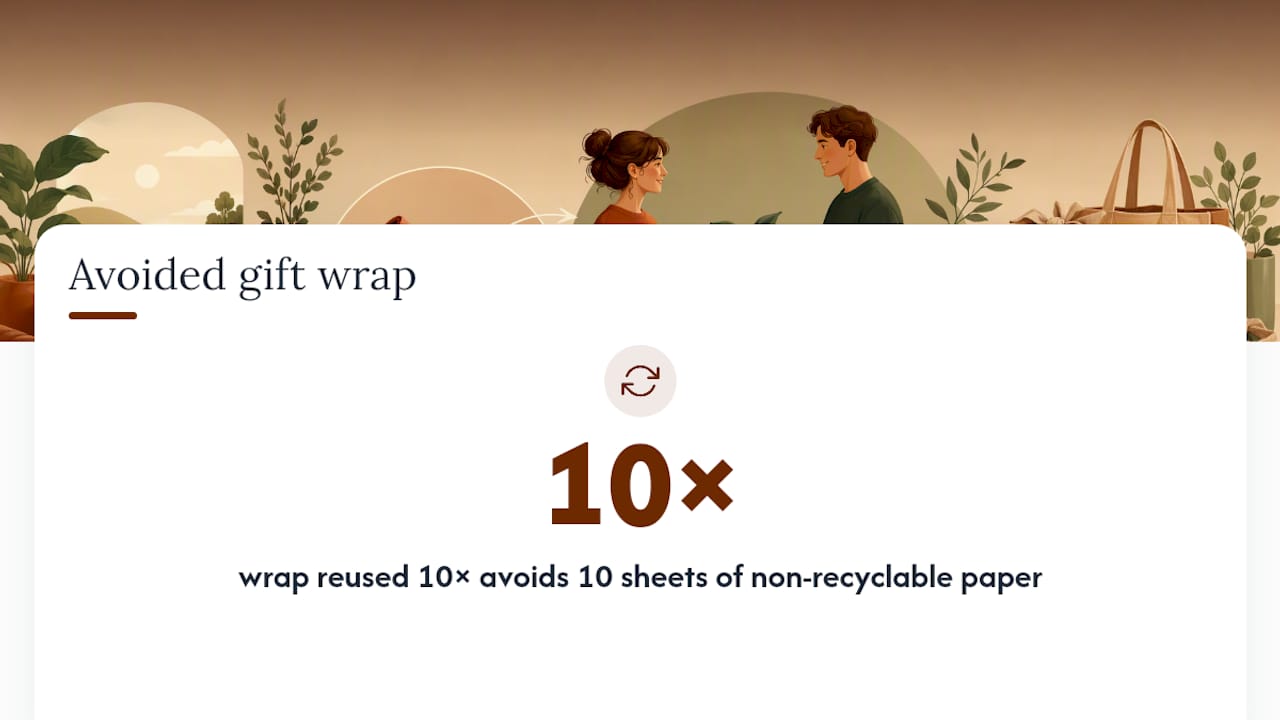
The lifecycle advantage of a fabric wrap versus single-use paper depends on reuse frequency. A wrap used across ten gifting occasions avoids ten sheets of non-recyclable decorative paper, each of which would otherwise enter general waste. The laundering footprint — water, energy, detergent — is real but modest relative to the waste avoided, particularly when cold or cool machine washing is used. Nicholasandrose recommends a cool machine wash and line dry, which minimises the energy component of each reuse cycle.
Pro Tip: When gifting a personalised fabric wrap for a newborn, choose a size that will grow with the child: a wrap sized for a baby shower gift can later wrap a toddler’s birthday present, then a school-age gift. Sizing up extends the reuse window and the emotional connection to the piece.
The claims above regarding reuse cycles and lifecycle benefits are based on brand guidance from Nicholasandrose and general lifecycle principles. Independent lifecycle assessment data specific to this product has not been published at the time of writing. Readers seeking verified figures should request care and reuse documentation directly from the brand.
Constraints and unintended consequences worth knowing
Honest packaging waste management requires acknowledging where interventions can worsen outcomes as well as improve them.
- Transport impacts of heavy reusables: glass bottles, ceramic containers, and heavy textile wraps all carry higher transport emissions per unit than lightweight single-use alternatives. The environmental benefit of reuse only materialises after enough reuse cycles to offset the higher production and transport footprint. For a cotton fabric wrap, lifecycle modelling typically suggests a breakeven point somewhere between three and seven reuses, depending on washing habits and transport distance.
- Laundering footprint: reusable fabric packaging requires washing between uses. Hot washing, tumble drying, and frequent cycles add water and energy use. Cool machine washing and line drying, as recommended by Nicholasandrose, substantially reduce this footprint, but the impact is not zero.
- Rebound effects and over-packaging: brands sometimes add packaging layers in the name of sustainability theatre — a recycled-content outer box around an already-protected product, or a branded cotton bag that the customer never reuses. This rebound effect can increase total material use while appearing to reduce it. The circular economy literature flags this as a persistent risk when sustainability claims are not backed by reuse data.
- Compostable packaging and infrastructure gaps: as noted earlier, compostable packaging is only genuinely beneficial where industrial composting infrastructure exists. Placing it in a general recycling bin contaminates the stream. In much of the UK, the collection infrastructure for compostables remains underdeveloped, meaning that compostable claims on packaging can mislead consumers into believing they are making a better choice when the end-of-life pathway does not exist locally.
- Recycling contamination: even genuinely recyclable packaging fails when it is contaminated with food residue or placed in the wrong bin. Consumer education remains a persistent gap, as the systematised review of packaging and food waste repeatedly emphasised. WRAP’s public communications work addresses this, but behaviour change at scale is slow.
The practical response to these constraints is evidence-based monitoring: track your actual reuse cycles, measure your material throughput before and after a packaging change, and use WRAP’s methodology or a third-party lifecycle assessment to validate claims before publishing them.
Verdict and practical recommendations for UK businesses and consumers
Packaging reduces waste most effectively when it is designed for reuse, sized to protect the product without excess, and compatible with the collection and sorting infrastructure that actually exists in the UK. The single highest-impact choice for both businesses and consumers is to prioritise reuse over recyclability: a packaging format that is used ten times and then recycled is almost always preferable to one that is recycled after a single use, because it displaces ten units of virgin material production.
For businesses, the immediate priorities are:
- Conduct an EPR-aware eco-design audit of your current packaging range, using the recyclability assessment framework set out in the Producer Responsibility Obligations Regulations 2024.
- Trial returnable or reusable packaging formats for your highest-volume product lines, and track reuse cycles from the outset.
- Engage with WRAP’s measurement frameworks to build the data you will need for credible waste-reduction claims and future EPR reporting.
For consumers, the steps are simpler but no less meaningful:
- Choose gift presentation that the recipient will keep: personalised fabric wraps, quality tins, and reusable pouches all outlast the occasion.
- Follow storage and date-labelling guidance on food packaging to reduce household food waste.
- Check your local authority’s recycling guidance before placing packaging in the kerbside bin, particularly for flexible plastics and coated paper.
The EU packaging regulation, which sets recyclability performance grades from 2030 and stricter obligations from 2038, signals the direction of travel for UK importers and businesses with EU supply chains. Designing for reuse and recyclability now is not merely good practice; it is preparation for a regulatory environment that will reward it.
A perspective on sustainable gifting and what it actually asks of us
There is a tendency in sustainability writing to treat packaging as a problem to be minimised rather than a resource to be managed. The evidence does not support that framing. Packaging, when designed well, prevents more waste than it creates — particularly in food systems, where the environmental cost of a spoiled product almost always exceeds the cost of the packaging that could have protected it.
What strikes me most, having spent time with the research and the UK policy landscape, is how much the conversation has shifted. The circular economy literature now frames packaging not as a waste burden but as a resource asset: something that should remain in active circulation for as long as possible, carrying value through multiple uses before it enters any recovery stream. That shift in framing has practical consequences for anyone buying gifts for a newborn or a child.
The gift-wrapping moment is fleeting. Paper is torn, discarded, and forgotten before the baby has been held by half the room. A personalised fabric wrap, by contrast, carries a name, a date, and a tactile quality that makes it worth keeping. The sustainability case and the emotional case point in the same direction, which is rare enough to be worth noting.
Where I think the conventional wisdom falls short is in its focus on materials rather than systems. Switching from plastic to paper, or from paper to compostable film, changes the substrate but not the behaviour. The behaviour that matters is reuse: choosing packaging that the recipient will keep, care for, and use again. For newborn and baby shower gifts, that means thinking beyond the wrapping paper aisle entirely.
Nicholasandrose: reusable fabric gift wrap for newborns and children
If the evidence in this guide has persuaded you that reuse is the highest-impact choice for gift presentation, Nicholasandrose offers a considered answer for newborn, baby shower, and children’s gifts. Each wrap is crafted from luxury cotton fabric and personalised with bespoke embroidery — a name, a birth date, a chosen motif — so the recipient has every reason to keep it long after the occasion has passed.
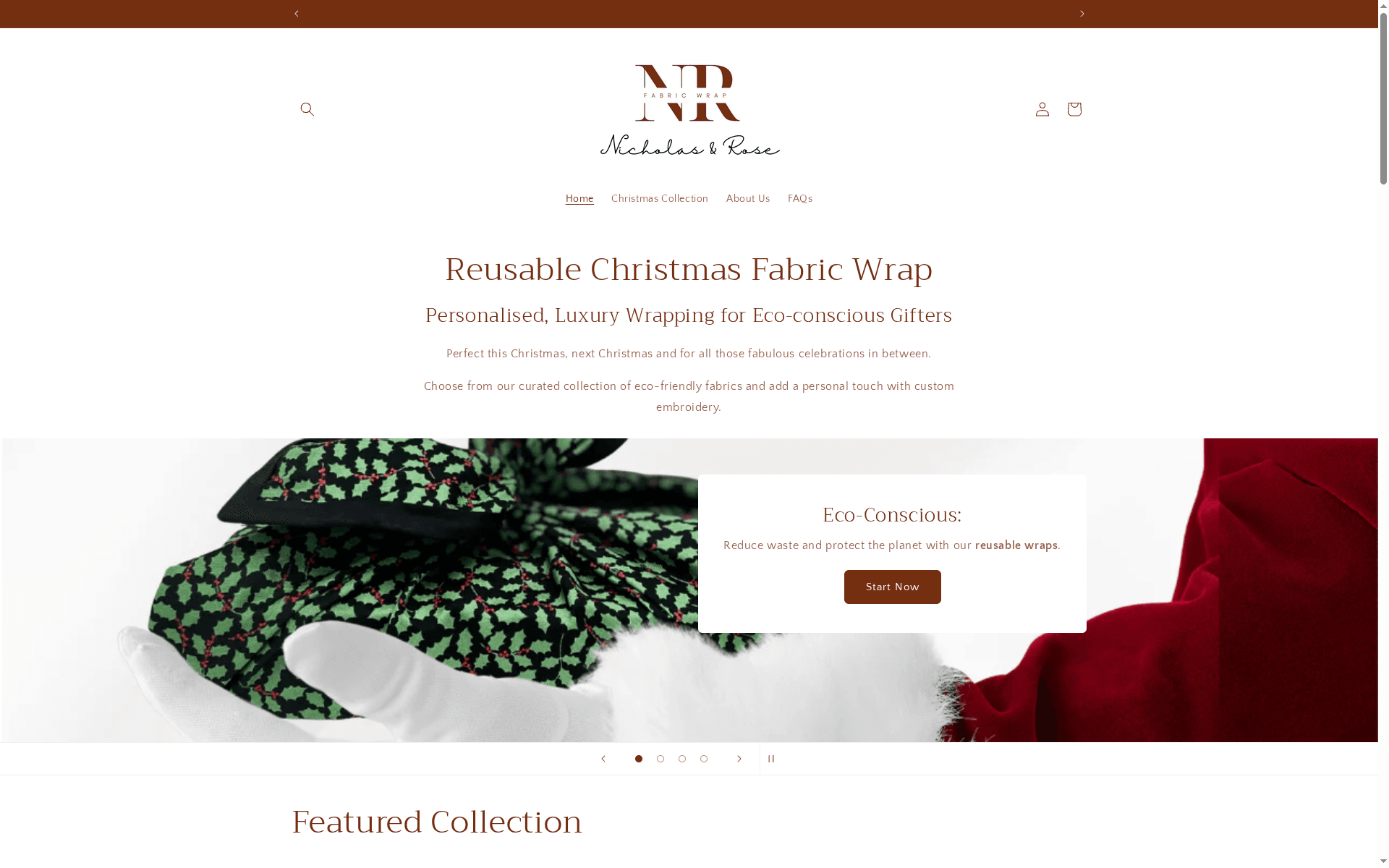
The 2026 newborn and toddler range brings new patterns and sizes designed to grow with the child, from the first baby shower gift through to early birthday presents. Cotton fabric that launders beautifully, embroidery that holds its crispness through repeated washes, and sizing that accommodates everything from a small keepsake to a generous gift bundle. Each wrap replaces multiple sheets of non-recyclable decorative paper across its lifetime of use, making it a genuinely practical choice for eco-conscious gift buyers who also want something beautiful and lasting.
Browse the full collection and personalise your wrap at Nicholasandrose — and explore the sustainable gifting guidance for ideas on how to present and care for your wrap so it earns every one of its reuse cycles.
Sources
The sources below represent the strongest authorities for UK packaging waste policy, lifecycle methodology, and consumer behaviour research. When reading lifecycle assessments or brand sustainability claims, look for transparent assumptions, stated reuse cycles, and comparison baselines — without these, figures are not comparable.
- Trash to profit: how packaging waste management has driven the circular economy—an integrative literature review
- Packaging and packaging waste (from 2026) | EUR-Lex
- The Producer Responsibility Obligations (Packaging and Packaging Waste) Regulations 2024
- The role of packaging in fighting food waste: a systematised review of consumer perceptions of packaging
- Products and services — Smurfit Kappa sustainable packaging
- RePack | Circular Tech Infrastructure
- Article on green premium and reusable packaging in luxury retail
- The role of packaging in reducing food waste — Invopak blog
Recommended
- Zero waste gift wrapping for UK parents: a 2026 guide – Nicholas & Rose Limited
- What is zero waste gifting: a 2026 guide for UK gift-givers – Nicholas & Rose Limited
- Educational list on gift wrap reuse: UK guide – Nicholas & Rose Limited
- Sustainable gift wrap UK: Eco-friendly tips for parents – Nicholas & Rose Limited