

Zero waste gift wrapping for UK parents: a 2026 guide
TL;DR:
- Zero waste wrapping using fabric or recyclable paper reduces landfill waste and offers personal, reusable gifts.
- Traditional wrapping creates high waste, while fabric wraps and kraft paper are eco-friendly, cost-effective, and versatile.
- Personal touches like embroidered wraps, botanical accents, and plantable tags enhance sustainability and sentimental value.
There is a quiet moment of disappointment that many eco-conscious parents know well: watching beautifully chosen wrapping paper torn away and tossed into a bin bag, often before the party has truly begun. At baby showers and toddler birthdays, the waste can feel relentless, pile upon pile of glitter-dusted paper and plastic ribbon destined for landfill. Yet the most thoughtful, elegant alternative is closer than you might imagine. This guide walks you through everything you need to create zero waste gift wrapping that is genuinely beautiful, deeply personal, and worthy of becoming a family heirloom in its own right.
Table of Contents
- Why choose zero waste wrapping for newborn and toddler gifts
- gather your zero waste wrapping supplies
- Step-by-step zero waste gift wrapping for boxes and soft toys
- How to wrap bottles, cylinders, and large toddler toys sustainably
- finishing touches: personalising and presenting your zero waste gift
- Why zero waste gift wrapping changes how we celebrate
- Make sustainable gifting simple with Nicholas & Rose
- frequently asked questions
Key Takeaways
| Point | Details |
|---|---|
| Furoshiki saves waste | Fabric wrapping techniques like furoshiki allow you to avoid tape, ribbon, and single-use gift wrap. |
| Cost-effective wrapping | Reusable cloth, bags, and recyclable paper save money and support UK recycling rules. |
| Personal presentation | Personalising your wrap with tags, botanicals and stories makes your gift memorable and meaningful. |
| Suits all shapes | Zero waste techniques can adapt to boxes, bottles, and large toys with ease. |
Why choose zero waste wrapping for newborn and toddler gifts
With zero waste wrapping increasingly popular, parents may wonder what makes these choices so impactful. The answer lies in both the tangible and the intangible: less landfill, lower costs over time, and a level of personalisation that no roll of shop-bought paper can rival.
Traditional gift wrap creates a staggering volume of waste each year in the UK, much of it non-recyclable due to glitter coatings, metallic finishes, and sticky tape contamination. For eco-conscious parents, sustainable fabric wraps offer a graceful way to sidestep that problem entirely. A single reusable cloth wrap, used across dozens of celebrations, quietly offsets what would otherwise be mountains of single-use paper.
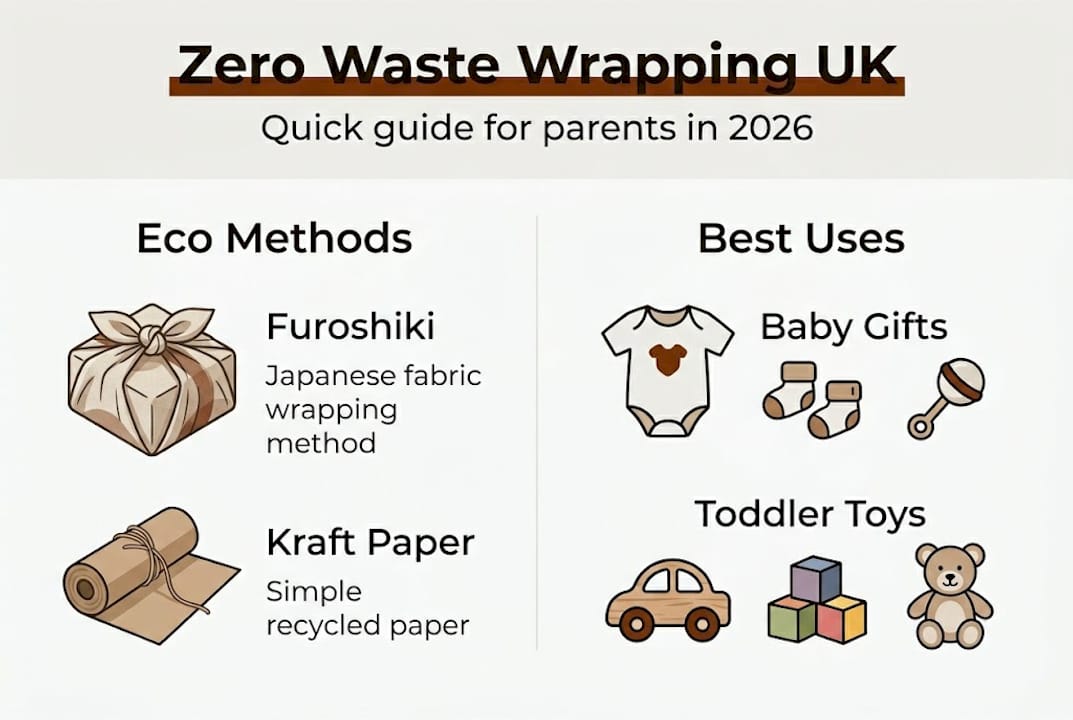
The financial case is equally compelling. Cost-effective long-term, fabric wraps cost mere pennies per use after the initial purchase, compared with the cumulative spend on rolls of paper, bags, and tissue. And unlike paper, a fabric wrap does not vanish into the bin. It becomes a swaddle, a play cloth, a treasured keepsake embroidered with a baby’s name.
The most impactful zero waste wrapping choices at a glance:
- Cotton, linen, or gauze furoshiki cloths: soft, washable, and endlessly reusable
- FSC-certified recyclable kraft paper: a strong secondary option when fabric is not available, fully compostable if plain
- Up-cycled scarves and thrifted tea towels: a charming, resourceful approach that supports UK charity shops
- Family heirloom fabric squares: personalised with embroidery and passed between generations
| Method | Environmental impact | Cost per use | Personal touch | UK recyclability compliant? | Best suited for… | No, wrong — see below |
Actually, here is a cleaner comparison:
| Method | Cost per use | Environmental impact | Best for newborns/toddlers? | UK recyclable? |
|---|---|---|---|---|
| Traditional wrapping paper | £0.40+ | High waste, often non-recyclable | No | Only if plain, no glitter |
| Plain kraft paper | £0.15–0.30 | Low, compostable | Yes | Yes |
| personalising fabric wraps | pennies per reuse | Very low | Yes, doubles as keepsake | N/A, reused |
| Up-cycled thrifted fabric | Near zero | Very low | Yes | N/A, reused |
Pro tip: In the UK, avoid any wrapping adorned with glitter, foil, or lamination. These cannot enter the recycling stream and will contaminate an otherwise clean collection. A crumple test is a reliable guide: if the paper springs back, it cannot be recycled.
gather your zero waste wrapping supplies
Understanding the ‘why’ behind zero waste wrapping, it is time to get practical about what you will actually need. The good news is that most of these materials are already close at hand or easily sourced from UK ethical retailers and charity shops.
Essential supplies for zero waste baby gift wrapping:
- Square fabric cloths in cotton, linen, or gauze (ideally 50–70cm for newborn gifts, 70–90cm for toddler boxes)
- FSC-certified kraft paper, costing approximately £0.15–0.30 per gift, as a compostable secondary option
- Natural jute or cotton twine for tying and finishing
- Up-cycled fabric from charity shops, including cotton scarves, muslin squares, and vintage tea towels
- Pre-assembled gift wrap sets with coordinated cloths and trimmings, ideal for baby showers
- dried botanical flourishes: lavender sprigs, baby’s breath, or rose petals for a nature-inspired finish
- plantable seed paper tags, which children can sow in a garden pot after the celebration
| Supply | Average UK cost | Where to source |
|---|---|---|
| Cotton furoshiki cloth | £4–£12 | Nicholas & Rose, ethical boutiques |
| FSC kraft paper | £0.15–0.30/gift | Paper merchants, eco supermarkets |
| Natural jute twine | £2–£4 per roll | Garden centres, craft shops |
| Up-cycled thrifted fabric | £0–£3 | UK charity shops, online marketplaces |
| plantable seed tags | £0.50–£1.50 | UK stationery and eco gift shops |
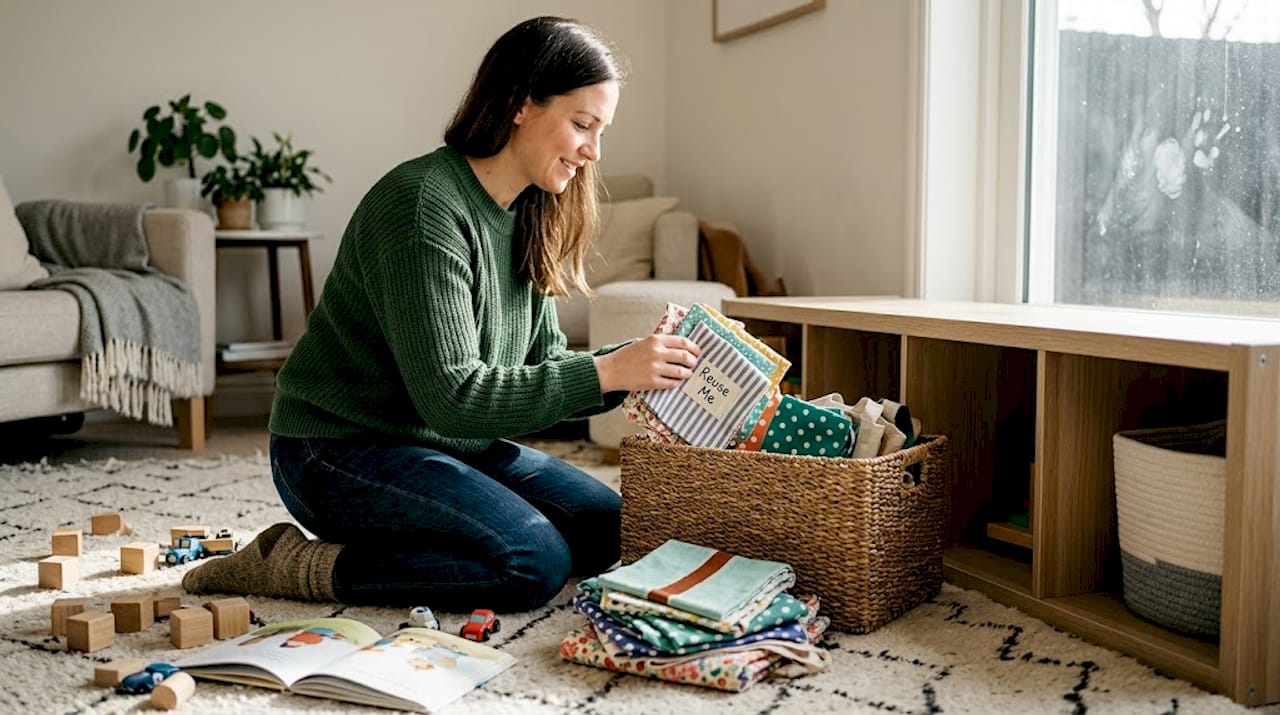
Pro tip: Begin collecting fabric squares well before a baby shower or birthday. A soft cotton muslin cloth bought during pregnancy can serve beautifully as a newborn swaddle and then, months later, be gifted back wrapped around a first birthday present. The story it carries makes it twice as meaningful.
Step-by-step zero waste gift wrapping for boxes and soft toys
Supplies in hand, let us look at exactly how to create fuss-free, zero waste wraps for the most common baby gifts. The furoshiki method, rooted in Japanese textile tradition, works with graceful simplicity.
For a boxed gift:
- Choose your cloth. Select a fabric square roughly two to three times the size of your gift.
- Position the cloth. Place the gift diagonally at the centre, with corners of the fabric pointing north, south, east, and west.
- fold the first corners. Pull the nearest and farthest corners up and over the gift, tucking them snugly beneath.
- Create the knot. Pull the remaining two corners upward and tie them in a neat square knot at the top of the gift. This becomes both the seal and the handle.
- adjust and smooth. Take a moment to straighten the folds, smooth the drape, and check that any embroidery or monogram faces forward.
For soft toys or irregular shapes:
- Centre the toy on the opened cloth, gathering the fabric gently around the shape.
- tuck and fold the excess inward, creating soft pleats rather than tight folds.
- tie at the top with a loose knot or a length of natural twine, allowing the fabric to billow gracefully.
“The furoshiki wrapping guide is at once the simplest and most refined way to present a gift, asking nothing more of you than a square of cloth and a moment of quiet attention.”
Pro tip: Leave a small handwritten note tucked inside the knot, gently asking the recipient to reuse the wrap. Most families, once they see how beautiful it looks, are delighted to keep it.
For further inspiration, our guide to fabric wrapping for gifts offers additional folding techniques suited to a range of present shapes.
How to wrap bottles, cylinders, and large toddler toys sustainably
Not all gifts are box-shaped; here is how to tackle tricky baby bottles and extra-large toys with the same elegance as a neatly wrapped box.
For a baby bottle or cylinder-shaped gift (baby oil, bath lotion, or a thermos):
- Open your cloth flat. A 50x50cm square works well for a standard bottle.
- Centre the bottle. Place the bottle at the centre, standing upright.
- Pull opposite corners up. Draw two opposite corners up around the neck of the bottle and tie them firmly above it.
- twist the remaining corners. Take the remaining two corners, twist each one gently, and bring them around the bottle to create elegant fabric handles.
- finish with a bow. tie the twisted handles together in a simple bow at the top for a graceful, gift-ready finish.
For large toddler toys:
reusable bags and boxes offer the most straightforward solution for oversized presents, particularly ride-on toys or boxed play sets. A sturdy fabric bag can be passed between family members across multiple celebrations, becoming a beloved part of the gifting ritual.
| Shape | Best zero waste method | key advantage |
|---|---|---|
| Box | furoshiki cloth wrap | elegant, reusable, embroiderable |
| bottle/cylinder | Corner-tie furoshiki | no scissors or tape needed |
| large or irregular toy | reusable fabric bag | suits all shapes; rotate within family |
| soft plush toy | gather-and-tie wrap | whimsical, tactile finish |
Pro tip: Build a small family collection of reusable bags in different sizes, labelled softly with each child’s name in embroidery. Watch them circulate at every celebration, gathering memories with each reuse. Our notes on eco-conscious wrap styling offer further ideas for building a cohesive gifting aesthetic. For seasonal celebrations, our eco checks for baby gifts provides a helpful seasonal overview.
finishing touches: personalising and presenting your zero waste gift
Once your gift is wrapped, it is time to make it truly unique and delightful. The finishing details are where zero waste wrapping moves from thoughtful to genuinely unforgettable.
Ideas for a luminous, personal presentation:
- plantable seed paper tags: write the baby’s name and a tender message, then invite the family to sow the tag in a pot of compost. The plantable tags add magic for kids and create a living memory of the celebration.
- dried botanical accents: tuck a sprig of dried lavender or a few rosebud heads beneath the wrap’s knot for a scent that lingers softly long after the gift is opened.
- hand-written notes in washable ink: use a calligraphy pen on a scrap of recycled card, tied with jute twine, to add a literary grace note.
- embroidered fabric wraps: commission or choose a wrap personalised with the baby’s name, birth date, or a meaningful motif. These become mementos far more precious than any paper tag.
- a story card: include a small card explaining the wrap and inviting the recipient to reuse it. Most families find this gesture unexpectedly moving.
Statistic worth noting: In the UK, an estimated 227,000 miles of wrapping paper is used each Christmas season alone, the majority of which goes straight to landfill. The custom gift wrap benefits for eco-conscious families extend well beyond any single celebration.
The eco-luxury wrap trends for 2026 show a clear movement toward personalised, tactile presentations that feel richer precisely because they are kinder to the world.
Pro tip: For a baby shower, consider presenting the gift with a second, unwrapped cloth alongside it, gently suggesting that it could become a swaddle, a muslin square, or a future wrap for another gift. The gesture plants an idea that tends to bloom beautifully.
Why zero waste gift wrapping changes how we celebrate
There is something quietly radical about arriving at a baby shower with a gift wrapped in a cloth rather than paper. It signals, without a word, that you have thought carefully about this moment. Children notice more than we realise. A toddler who watches a parent unwrap a gift in soft, reusable fabric and then repurpose that cloth as a play blanket is learning something no educational toy can teach: that beauty and thoughtfulness and care for the world are not in conflict with celebration.
We have long held a cultural assumption that generous gifting means extravagant wrapping. The more rustling layers, the more lavish the gesture. But this conflation is worth questioning. The most memorable gifts we have witnessed have often arrived in the simplest wrapping, held by a single knot, adorned with nothing more than a sprig of dried flowers and a name reduce waste with fabric gently embroidered into the cloth.
Zero waste wrapping does not diminish celebration. It deepens it, by asking us to slow down, to choose with intention, and to offer something that endures beyond the morning’s unwrapping. That, we believe, is the truest form of generosity.
Make sustainable gifting simple with Nicholas & Rose
Ready to put these steps into action for your next celebration? At Nicholas & Rose, we have created a new 2026 range of reusable fabric gift wraps designed especially for newborns and toddlers, each one available with bespoke embroidery to carry a baby’s name, birth date, or a tender motif into the years ahead.
Our wraps are crafted to be used, loved, and reused across every celebration that follows. From baby showers to first birthdays and beyond, they replace the single-use paper that too often ends in the bin before the day is done. Browse our curated collection and discover how beautifully sustainable gifting can feel, for both the giver and the little one who unwraps it.
frequently asked questions
What fabric is best for zero waste baby gift wrapping?
Cotton, linen, or gauze cloths are the finest choices, being soft, washable, and gentle enough for newborn skin, while also holding their shape and beauty across dozens of reuses.
Are kraft paper gift wraps really eco-friendly?
Plain, FSC-certified kraft paper is both fully recyclable and compostable, making it a sound zero waste option provided it carries no glitter, foil, or tape residue.
Can zero waste wraps be used more than once?
Absolutely. A well-chosen fabric wrap can be reused 10 to 50 times or more, meaning the cost per use falls to almost nothing while the sentimental value only grows.
Does zero waste wrapping work for awkwardly shaped gifts?
Flexible fabric and reusable bags for toddler toys accommodate almost any shape, from plush animals to large boxed games, with a gentle gather-and-tie technique that looks intentional and beautiful.
How do I add a personal touch to sustainable gift wrapping?
Tuck a plantable tag for baby showers beneath the knot, tie with a sprig of dried lavender, or choose a fabric wrap embroidered with the baby’s name for a finish that feels genuinely bespoke.
Recommended
- Sustainable gift wrap UK: Eco-friendly tips for parents – Nicholas & Rose Limited
- 7 Steps to a Gift Wrap Sustainability Checklist for Parents – Nicholas & Rose Limited
- Eco-conscious holiday checklist: sustainable gifts for UK parents – Nicholas & Rose Limited
- Luxurious eco wrapping ideas for UK newborn gifts – Nicholas & Rose Limited
- Sustainable fashion options for conscious women in 2026 – Prima Dons & Donnas