

Holiday sustainability checklist for newborns and baby showers
Before you buy personalised, reusable cotton gift wrap for a newborn, baby shower or child’s birthday, run through these seven checks: fabric and certifications, baby safety, sizing, personalisation options, lead time, care instructions, and return or exchange policy. A wrap that passes all seven is genuinely purchase-ready.
- Fabric and certifications: look for OEKO-TEX Standard 100 or GOTS-certified cotton; both confirm the fabric is free from harmful substances.
- Baby safety: no loose ribbons, detachable trims or small embellishments that could pose a choking hazard.
- Sizing: confirm the wrap fits the gift category (newborn swaddle, small outfit, toy, or memory box).
- Personalisation options: check whether embroidery includes name, date, a short message or a ‘made by’ note.
- Lead time: allow at least two to three weeks for personalised embroidery; more during peak seasons.
- Care instructions: washing guidance should be clearly stated on the product page.
- Return or exchange policy: personalised items are often non-returnable, so verify spelling before confirming.
Pro Tip: At family gatherings, designate one person to collect and fold the wrap after opening so it travels home with the giver, ready to be used again at the next celebration. A simple ribbon tag with the giver’s name makes retrieval effortless and keeps the eco gift wrapping workflow alive across occasions.
Key takeaways
Personalised, reusable cotton gift wrap is the most sustainable choice for newborn and baby shower gifts because personalisation increases retention, and retention is what makes the environmental case work.
| Point | Details |
|---|---|
| Check certifications first | Look for OEKO-TEX Standard 100 or GOTS on the product page before anything else. |
| Allow two to three weeks | Personalised embroidery orders need at least two to three weeks; order earlier during peak seasons. |
| Personalisation drives retention | Names, dates and ‘made by’ signals increase appreciation and make recipients far less likely to discard the wrap. |
| Reuse breaks even quickly | Using a wrap across three to four occasions offsets its production footprint versus single-use paper. |
| Nicholasandrose for newborns | The 2026 newborn and toddler range offers certified cotton, bespoke embroidery and UK shipping with clear care guidance. |
Table of Contents
- Does your holiday sustainability checklist cover every detail?
- Why does personalised, reusable wrap matter for baby gifts?
- What materials and safety marks should you check for baby gifts?
- How do you choose the right size and style for a newborn or toddler?
- Which personalisation choices make the biggest difference?
- How should you care for and repair a reusable wrap?
- How much packaging waste does switching to reusable wrap actually save?
- What should personalised embroidered wraps cost, and how far ahead should you order?
- How do you find a trustworthy UK seller for personalised fabric wrap?
- What other eco-friendly wrapping options are worth considering?
- Can gifting experiences or consumables reduce wrapping waste altogether?
- How can children help with sustainable gift wrapping?
- How does personalised reusable wrap compare to other sustainable wrapping on environmental impact?
- Why this checklist focuses on newborns and toddlers
- Nicholasandrose personalised reusable cotton wraps for newborns
- Sources
Does your holiday sustainability checklist cover every detail?
Each of the seven checks above carries its own weight. Here is what to look for when you dig deeper into a product listing.
- Material: 100% cotton is breathable, washable and gentle against newborn skin. Blended fabrics may pill or shrink unevenly.
- Certifications: OEKO-TEX Standard 100 and GOTS are the two most trusted marks. If neither appears on the product page, ask the seller directly.
- Embroidery quality: look for tight, flat stitching with no loose threads on the reverse; loose threads are a safety concern for very young babies.
- Sizing: see the table below for a quick reference.
- Lead time: essential for personalised orders; treat it as non-negotiable.
- Care and repair guidance: clear washing instructions extend the wrap’s life significantly.
- End-of-life plan: a worn wrap can be donated to a textile bank or repurposed as a cleaning cloth rather than sent to landfill.
| Wrap size (approx.) | Suitable for |
|---|---|
| Around small square size | Newborn swaddle, small soft toy |
| Medium square size | Baby clothing set, small gift box |
| Larger square size | Toddler outfit, medium toy, memory box |
| Extra large square size | Children’s birthday gift, book set |
For new parents, certifications and lead time are essential; style and message length are nice-to-have refinements that deepen the gift’s sentimental value.
Why does personalised, reusable wrap matter for baby gifts?
Personalisation does more than look beautiful. University of Bath research shows that personalised gifts create stronger emotional bonds between giver and recipient, increasing how much the recipient values and keeps the item. That emotional attachment is precisely what turns a piece of cotton wrap into a keepsake rather than a bin-liner.
For a newborn gift, that retention matters doubly. The wrap itself becomes part of the child’s story, folded away with first photographs and tiny shoes. Choosing personalised gifting for eco-conscious families means the wrap is unlikely to be discarded after a single use, which is the single most powerful sustainability argument for choosing fabric over paper.
What materials and safety marks should you check for baby gifts?
Choose OEKO-TEX Standard 100 or GOTS-certified cotton, non-toxic dyes and secure embroidery. Here is what to verify on the product page before you order.
- Fibre content: 100% cotton, clearly stated.
- Dye and print method: water-based or reactive dyes only; avoid listings that do not specify.
- Certification badge: OEKO-TEX or GOTS logo should be visible, not merely claimed in text.
- Embroidery finish: confirm the reverse is neatly finished with no trailing threads.
- Trims and additions: avoid wraps with detachable buttons, beads or ribbons intended for decoration rather than function.
- Laundering temperature: 30°C or 40°C wash guidance is standard for certified cotton; check it is stated.
Pro Tip: For a newborn present specifically, choose a wrap with no added trims at all. A beautifully embroidered name on clean cotton is safer and, frankly, more elegant than any ribbon could be. See sustainable certification guidance for what each mark actually guarantees.
How do you choose the right size and style for a newborn or toddler?
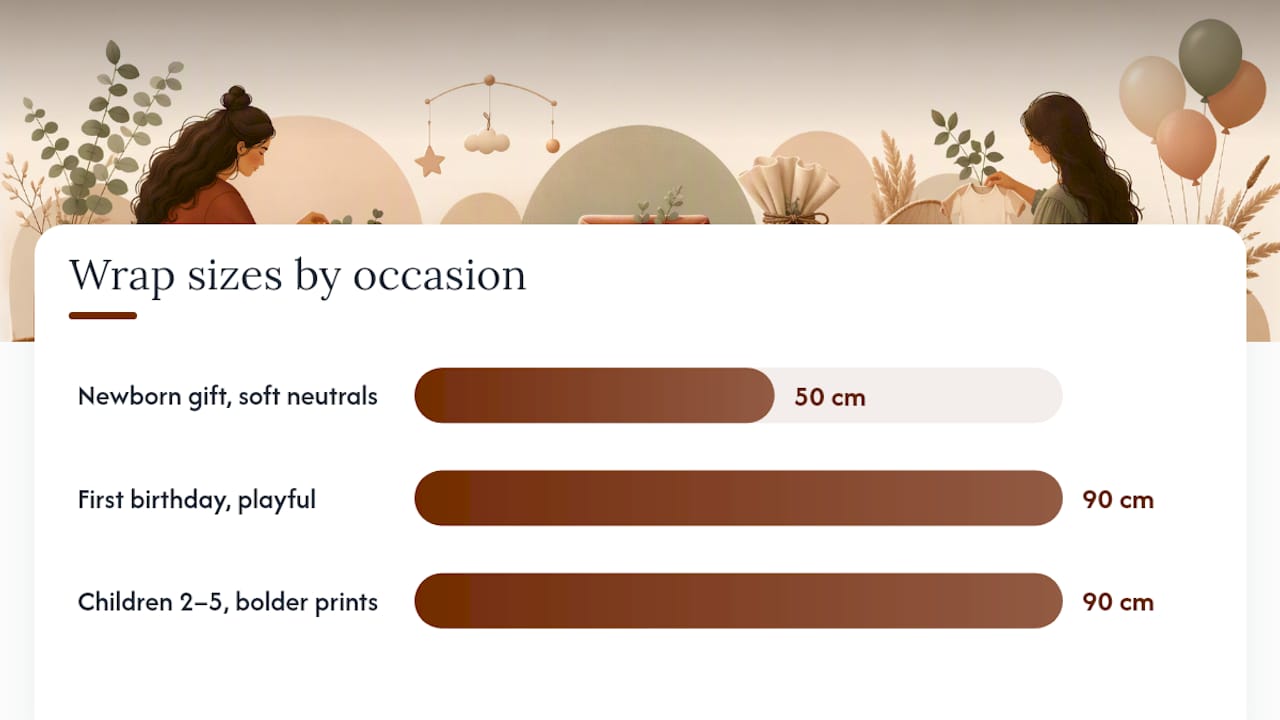
Match the wrap size to the gift category first, then consider style. A 50 × 50 cm square suits a newborn swaddle or soft toy; a 90 × 90 cm wrap accommodates a toddler outfit or memory box with ease.
| Occasion | Recommended size | Style notes |
|---|---|---|
| Newborn gift or baby shower | 50 cm | Soft neutrals, botanical prints, gentle embroidery |
| First birthday | 90 cm | Playful patterns, name and date embroidery |
| Children’s birthday (ages 2–5) | 90 cm | Bolder prints, character-friendly colours |
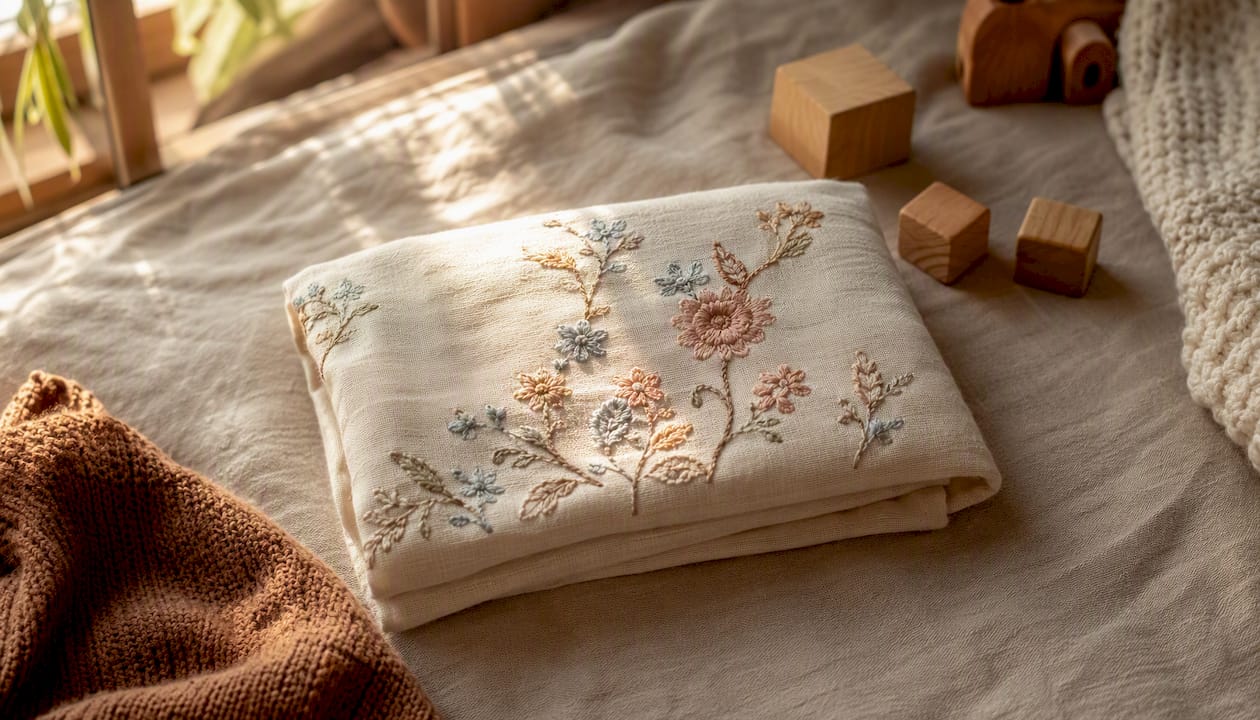
For style, neutral and botanical prints age well and suit any nursery palette, making the wrap more likely to be reused as a playmat, swaddle or keepsake cloth. Gender-neutral designs extend the wrap’s life across siblings and future occasions. Embroidery placement along one edge rather than centred keeps the design visible when the wrap is folded and stored, a small detail that innovative holiday wrapping ideas for little ones often overlook.
Which personalisation choices make the biggest difference?
Names, dates and ‘made by’ signals increase appreciation and encourage care, according to University of Bath findings. The giver’s effort, made visible through embroidery, is what elevates a practical item into something treasured.
- Name: the most impactful single addition; use the child’s full given name or a chosen nickname.
- Date of birth or occasion date: anchors the wrap to a specific memory.
- ‘Made by’ or ‘gifted by’ note: a short phrase such as “With love from Grandma” signals effort and increases the recipient’s sense of being known.
- Short message: keep to eight words or fewer for clean embroidery placement.
- Stitch placement: edge placement reads clearly when the wrap is folded; centre placement makes a stronger visual statement when the wrap is displayed.
The role of personalisation in sustainability is straightforward: a wrap bearing a child’s name is almost never thrown away.
Pro Tip: Ask the seller for a digital proof of the embroidery layout before production begins. Catching a spelling error at proof stage costs nothing; correcting it after stitching is often impossible on a non-returnable item.
How should you care for and repair a reusable wrap?
Correct laundering and basic repairs will multiply the number of times a wrap can be used, turning a single purchase into years of gifting.
- Wash at 30°C on a gentle cycle using a mild, fragrance-free detergent; this preserves both the cotton fibres and the embroidery thread.
- Avoid tumble drying where possible; lay flat or hang to dry away from direct sunlight to prevent fading.
- Iron on a low setting with the embroidered side face-down to protect the stitching.
- Re-stitch loose threads promptly using a matching embroidery thread and a blunt needle; a loose thread left unattended can unravel a larger section.
- Patch small tears with an iron-on cotton patch in a complementary colour; a visible mend, done neatly, adds character rather than detracting from it.
- Remove baby stains by soaking the affected area in cold water with a small amount of gentle soap before washing; hot water sets protein-based stains.
- Store folded in a cotton bag or pillowcase in a dry drawer; avoid plastic bags, which trap moisture and can cause mildew over time.
How much packaging waste does switching to reusable wrap actually save?
Switching to reusable fabric wrap reduces the volume of single-use packaging entering the household waste stream. Gov include provisional packaging waste figures up to 2024, confirming that packaging remains a significant component of household waste nationally.
A simple household calculation: if a family wraps eight gifts per year using a single sheet of wrapping paper per gift, switching to two reusable wraps used across four occasions each eliminates those eight sheets annually. Over five years, that is forty sheets of paper, plus the associated tape, tissue and bag waste, kept out of the bin.
The honest caveat is that a cotton wrap carries its own production footprint. The environmental case rests on reuse: fabric gift wrapping guidance confirms that the upfront cost and footprint of a fabric wrap are offset once it replaces several rounds of single-use paper. For newborn gifts especially, where the wrap often becomes a keepsake, that threshold is reached quickly.
- Reuse across multiple occasions to break even on production impact.
- Personalisation increases the likelihood of retention, accelerating that payback.
- At end of life, donate to a textile bank rather than sending to general waste.
What should personalised embroidered wraps cost, and how far ahead should you order?
Personalised embroidered cotton wraps typically cost more than a roll of single-use paper, but the cost per use falls with every reuse. Expect to pay in the range of £20–£50 for a quality personalised wrap in the UK, depending on size, fabric weight and embroidery complexity.
- Standard lead time: two to three weeks for personalised embroidery orders.
- Peak seasons (October to December, spring baby shower season): allow four weeks or more.
- Express options: some UK sellers offer faster turnaround; check the product page for stated production times before ordering.
- Budget tip: a single well-chosen wrap at £30–£40 replaces years of paper, ribbon and tissue, making the per-occasion cost lower than it first appears.
Eco-conscious gifting trends show growing demand for personalised sustainable gifts, which means production slots fill earlier each season. Order as soon as the occasion date is confirmed.
How do you find a trustworthy UK seller for personalised fabric wrap?
Choose sellers who publish their materials, certifications, care instructions and lead times clearly. A seller who cannot answer a direct question about fibre content or dye method is not one to trust with a newborn gift.
Seller criteria checklist:
- Fabric content and certifications stated on the product page (not just in marketing copy).
- Clear embroidery options with a preview or sample image.
- Stated production and dispatch times for personalised orders.
- UK-based contact details or a responsive customer service channel.
- Genuine customer reviews that mention personalisation quality and packaging.
- A clear policy on errors in personalisation (what happens if the name is misspelled on their side).
Questions to ask before ordering:
- Which certification does this fabric hold: OEKO-TEX Standard 100 or GOTS?
- Can you send a digital proof of the embroidery layout before production?
- What is your current lead time for personalised orders?
- What is your policy if I need to amend the personalisation after ordering?
- Do you offer a repair or replacement service for embroidery faults?
Buyer guidance for personalised baby gifts consistently highlights that customised items are often non-returnable, making pre-order verification the most important step in the process.
What other eco-friendly wrapping options are worth considering?
Personalised reusable fabric wrap is not the only thoughtful alternative to single-use paper. A few other approaches suit different occasions and budgets.
Furoshiki-style fabric squares use the Japanese wrapping technique with any square of cotton or linen; they work beautifully for irregularly shaped gifts and can be sourced from fabric offcuts. Recycled kraft paper with natural twine and dried botanicals is fully compostable and suits gifts where a keepsake wrap is not the intention. Beeswax wraps suit small, flat gifts and double as kitchen wraps afterwards. Brown paper bags from recycled stock, decorated with a rubber stamp or a sprig of rosemary, are a zero-fuss option for consumable gifts.
For holiday keepsake ideas that extend beyond the wrap itself, WonderLens holiday keepsake ideas offers curated inspiration for families who want the gift and its presentation to be equally memorable.
Can gifting experiences or consumables reduce wrapping waste altogether?
The most sustainable wrap is sometimes no wrap at all. Gifting an experience (a family swim session, a baby sensory class, a portrait sitting) or a consumable (a hamper of organic baby toiletries, a subscription to a story service) removes the packaging question entirely. A beautifully written card describing the experience, tucked inside a small reusable envelope, creates a moment of anticipation without a single sheet of paper.
For baby showers specifically, group gifts pooled towards a larger experience or a quality keepsake item reduce the volume of individually wrapped presents, which is where much of the occasion’s packaging waste originates.
How can children help with sustainable gift wrapping?
Involving children in wrapping makes the practice feel natural rather than obligatory. A toddler who helps fold and tie a fabric wrap begins to understand, in the most concrete way, that the wrap is part of the gift rather than something to be torn off and discarded.
Practical ways to involve children:
- Let them choose the wrap pattern from a small selection, giving them ownership of the choice.
- Teach a simple fold (the basic furoshiki knot takes under a minute) as a shared ritual before birthdays.
- Ask them to draw a small card to tuck inside, so their contribution is visible alongside the wrap.
- After the gift is opened, involve them in folding and storing the wrap for next time, framing it as caring for something precious.
Children who grow up treating wrapping as reusable carry that habit into adulthood, which is a longer return on investment than any single sustainable purchase.
How does personalised reusable wrap compare to other sustainable wrapping on environmental impact?
Personalised reusable cotton wrap sits at the higher end of the environmental payoff spectrum, provided it is used repeatedly. Here is how it compares to other sustainable options.
Recycled paper is a genuine improvement on virgin-fibre paper but remains single-use; it reduces the production footprint without eliminating disposal. Furoshiki-style plain fabric squares are reusable and low-cost but carry no personalisation, making them less likely to be retained long-term. Beeswax wraps are reusable for small gifts but have a limited lifespan and are not suitable for newborn contact. Personalised embroidered cotton wrap, by contrast, combines reusability with the emotional retention that personalisation research confirms increases care and longevity. The personalisation is not a luxury addition; it is the mechanism that makes the sustainability case work.
Why this checklist focuses on newborns and toddlers
The safety and sentimental requirements for newborn gifts are more specific than for any other age group. Fabrics must be certified, embroidery must be safely finished, and the wrap itself is likely to become a keepsake rather than a functional item the child outgrows. That combination of safety rigour and lasting emotional value is why the checklist above prioritises certifications and personalisation choices above all else.
The Nicholasandrose 2026 newborn and toddler range was developed with precisely these requirements in mind: certified cotton, carefully finished embroidery, and sizing that suits the earliest and most precious milestones. When a wrap is made to this standard, it does not end up in the bin before the baby is even born.
Nicholasandrose personalised reusable cotton wraps for newborns
Every new arrival deserves a gift that lasts beyond the morning of unwrapping. Nicholasandrose offers luxury personalised wraps for newborns and milestones in certified cotton, with bespoke embroidery options that include the child’s name, date of birth and a short message. The 2026 newborn and toddler range ships within the UK, with clear care instructions and stated lead times for every personalised order.
Browse the Baby & Beyond collection to find the right size and pattern for your occasion, and check the product page for current personalisation lead times before you order.
Sources
- Personalised gifts create lasting emotional connections and enhance self‑esteem — University of Bath
- Personalized gifts create lasting emotional connections and enhance self‑esteem | ScienceDaily
- Gov
- How to save money and the planet with fabric gift wrapping | Natural Baby Shower
Recommended
- Christmas eco checklist: sustainable gift wraps for newborns – Nicholas & Rose Limited
- The role of gifting in sustainability for parents – Nicholas & Rose Limited
- Eco-conscious holiday checklist: sustainable gifts for UK parents – Nicholas & Rose Limited
- Assembling a Gift Wrap Set for Sustainable Newborn Gifts – Nicholas & Rose Limited