

Holiday wrap waste: how to gift beautifully and sustainably
TL;DR:
- UK holiday wrap waste surges each December, much of it unrecyclable and dumped in landfills.
- Most decorative wrapping paper, especially foil and glitter coated, is not recyclable and contaminates recycling.
- Reusable fabric wraps offer a sustainable, meaningful alternative that reduces waste and carries sentimental value.
Every December, a quiet but significant event unfolds in households across the United Kingdom. Rolls of glittering, foil-stamped, plastic-coated wrapping paper are torn open in moments of joy, then swept straight into the bin. Many people assume most of this paper will be recycled, yet UK wrap waste floods recycling centres every December, with much of it ultimately ending up in landfill. For eco-conscious parents and gift-givers who care deeply about the world they are handing to their children, the scale of this seasonal problem is worth understanding fully, and the alternatives are far more beautiful than you might expect.
Table of Contents
- What is holiday wrap waste?
- Why most wrapping paper isn’t recyclable
- The local rules and confusion around recycling
- Practical alternatives: reusable, luxurious, and family-friendly wraps
- Our take: what most guides miss about holiday wrap waste
- Ready to make your holidays waste-free?
- Frequently asked questions
Key Takeaways
| Point | Details |
|---|---|
| Holiday wrap waste is massive | Millions of tonnes of wrapping paper and packaging are discarded in the UK every holiday season. |
| Not all paper is recyclable | Glitter, foil, and plastic-coating prevent most wrapping paper from being recycled. |
| Local rules vary | Recyclability depends on material, contamination, and local council policies—always check before recycling. |
| Reusable wraps are best | Luxurious, fabric wraps cut waste and create lasting family traditions. |
What is holiday wrap waste?
Holiday wrap waste is, in its simplest form, everything used to present a gift that becomes rubbish once the gift is opened. But the reality is richer and more troubling than that neat definition suggests.
Holiday wrap waste includes wrapping paper, gift bags, ribbons, tapes, tissue paper, and all the decorative packaging that briefly adorns a present before being discarded. In the United Kingdom, December brings an extraordinary surge of this material, with recycling centres reporting volumes that strain their capacity year after year.
Consider what typically goes into wrapping a single gift for a newborn or toddler:
- Wrapping paper, often glittery, foil-printed, or laminated
- Sellotape and adhesive labels, which are almost never recyclable
- Ribbons and bows, usually made from plastic or mixed synthetic fibres
- Tissue paper, which may or may not be recyclable depending on its composition
- Gift bags, frequently coated with plastic or decorated with non-paper elements
“The festive season generates a remarkable surge of packaging waste that tests every recycling system in the country, much of it too contaminated or composite to process.”
When you are choosing gifts for a new arrival or a growing toddler, the wrapping itself deserves as much thoughtful consideration as the gift within it. Exploring sustainable gift wrap choices is not merely a fashionable pursuit; it is a genuinely meaningful act that ripples outward into the values your family builds together.
Now that we see the broad environmental footprint, let’s examine what makes some wrapping paper particularly problematic to recycle.
| Type of wrap | Commonly used | Goes to landfill? |
|---|---|---|
| Plain brown paper | Moderate | Rarely |
| Foil wrapping paper | Very common | Usually |
| Glitter-coated paper | Very common | Almost always |
| Plastic-coated gift bags | Common | Almost always |
| Fabric wraps | Uncommon but growing | Never (reusable) |
The contrast within that table tells a story. The most beloved, most visually spectacular wrapping options are almost always the worst offenders environmentally. The most sustainable choices are, paradoxically, often the most refined.
Why most wrapping paper isn’t recyclable
This is where the gap between perception and reality becomes strikingly clear. Many of us grew up believing that paper, by its very nature, is recyclable. Paper comes from trees, trees are natural, therefore paper returns to the earth. Elegant logic, but incomplete.
Glitter, foil or plastic-coated wrapping paper is unlikely to be recyclable and should be disposed of as general waste. The glitter particles, the metallic sheen, the satisfying crinkle of a laminated surface; these qualities that make wrapping paper feel luxurious are precisely what render it unacceptable to most recycling facilities.
Here is a simple numbered guide to making better decisions at the wrapping table:
- Check for glitter. Even a light dusting of glitter makes paper unrecyclable. Glitter is micro-plastic and contaminates entire batches of otherwise good material.
- Feel for plastic coatings. Run your fingernail across the surface. If it feels smooth and slightly waxy rather than papery, there is almost certainly a plastic laminate present.
- Look at the sheen. Highly reflective, mirror-like paper is foil-backed and unrecyclable. A matte or slightly textured surface is a better sign.
- Perform the scrunch test. The scrunch test is a quick way to check recyclability. Scrunch the paper firmly in your hand and release. If it holds the scrunched shape, it is likely recyclable. If it springs back, it contains foil or plastic and should go in general waste.
- Remove all tape and embellishments first. Even perfectly recyclable paper becomes contaminated when tape, ribbons, and labels remain attached.
Pro Tip: Before you reach for the recycling bin on Boxing Day, do the scrunch test on every sheet. You may be surprised how few of the prettiest papers pass. Separate the recyclable from the non-recyclable before disposal, and you will avoid accidentally contaminating an entire bin bag of recyclable material.
| Wrapping paper type | Scrunch test result | Recyclable? |
|---|---|---|
| Plain kraft paper | Holds shape | Yes |
| Matte printed paper | Usually holds shape | Often yes |
| Glossy coated paper | Springs back | No |
| Foil paper | Springs back | No |
| Glitter paper | Holds shape but contaminates | No |
Our holiday wrapping guide expands on these distinctions with practical advice for every gifting occasion, and our round-up of top sustainable gift wrap solutions offers genuinely beautiful alternatives to the conventional choices.
After understanding what can and cannot be recycled, parents and gift-givers should know how local rules add another layer of complexity entirely.
The local rules and confusion around recycling
Even if you have performed the scrunch test and stripped all tape from your wrapping paper, your local council may still reject it. This is one of the most frustrating and least understood aspects of holiday wrap waste in the UK.
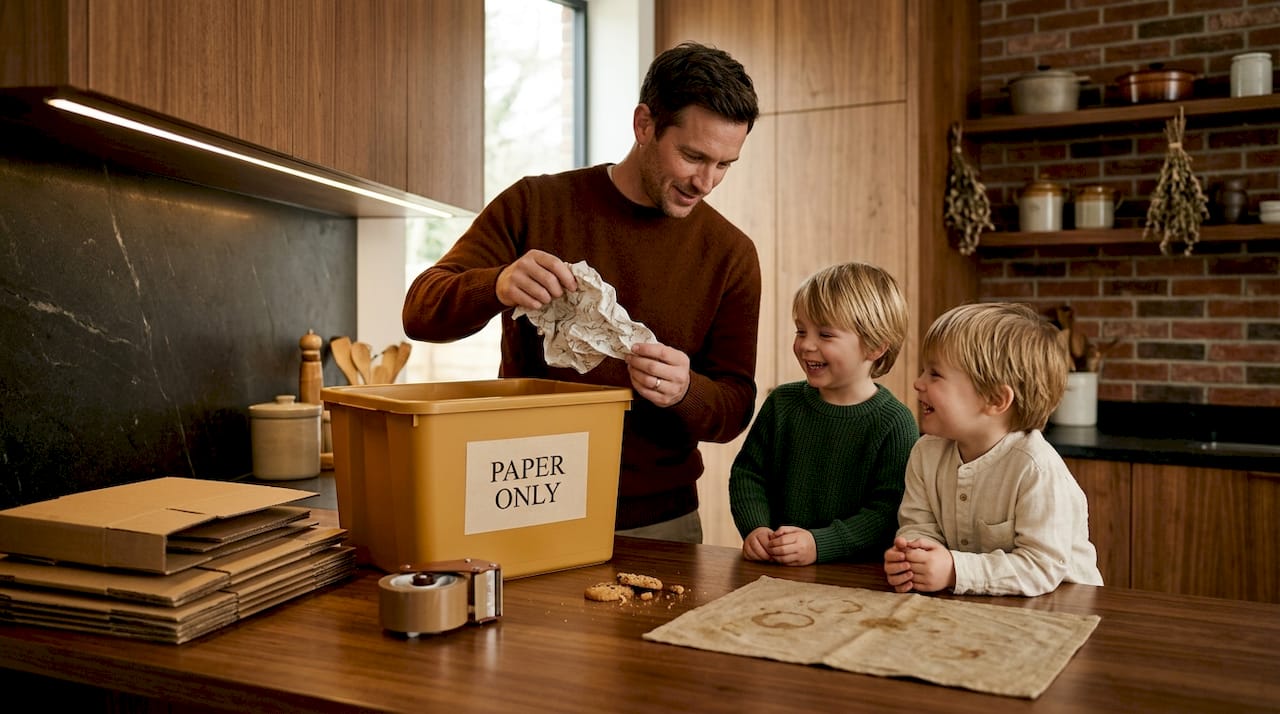
Recyclable-looking wrapping paper may be rejected by your local council due to contamination risks, which is why checking your council’s specific waste guidance is so important. The patchwork of local authority rules across England, Scotland, Wales, and Northern Ireland means that what is accepted in one postcode may be rejected in another.
Key points to be aware of when navigating local recycling rules:
- Some councils accept no wrapping paper at all, regardless of its composition, simply because the risk of contamination is too high to manage efficiently.
- Kerbside collection and household waste sites may operate under different rules within the same council area.
- Contamination from non-paper materials such as tape, ribbon, or even the ink on some printed papers can cause entire batches of recycling to be rejected and sent to landfill.
- Wishcycling (placing items in recycling bins in the hope they will be recycled, without certainty) actually increases contamination and can make recycling outcomes worse overall.
“When in doubt, leave it out. Placing non-recyclable materials in your recycling bin does not give them a second chance. It risks ruining an entire lorry-load of genuinely recyclable material.”
Non-paper embellishments and mixed materials lead to council recycling rejection even when the main paper seems recyclable. This includes the adhesive on tape, the dye in ribbon, and the synthetic fibres in bows. Removing all of these before placing paper in a recycling bin is the minimum responsible step, but it is also time-consuming and easy to overlook in the post-celebration rush.
Pro Tip: Bookmark your local council’s waste and recycling webpage in December so you can check guidance before the gifting season reaches its peak. Many councils update their advice annually, and a five-minute check can prevent weeks of well-intentioned but ultimately harmful wishcycling.
For those who want to approach gifting with genuine confidence rather than guesswork, exploring luxurious eco wrapping removes the complexity entirely. Our wrapping checklist for parents is also a practical companion to keep close during the festive preparations.
Given the complications and inconsistencies of recycling, let’s explore what families can do differently to reduce holiday wrap waste at its source.
Practical alternatives: reusable, luxurious, and family-friendly wraps
The most effective way to eliminate holiday wrap waste is elegantly simple: stop creating it in the first place. Reusable fabric wraps make this not only possible but genuinely pleasurable.
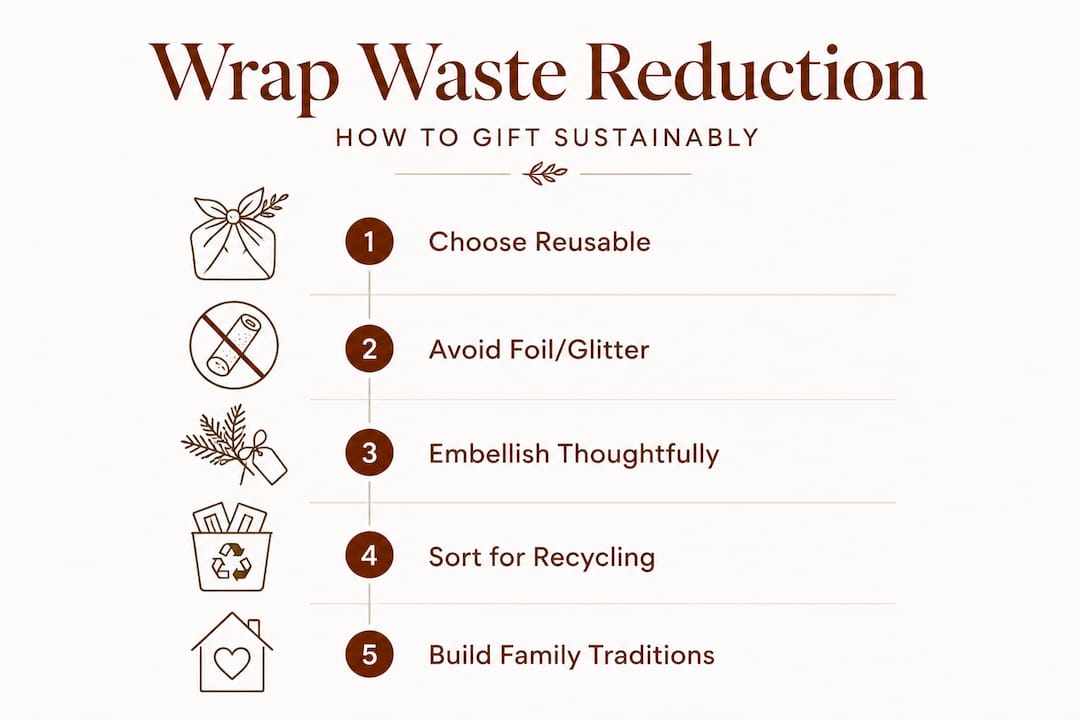
Reusable gift wrap offers a meaningful way to cut down on holiday waste, and fabric solutions are especially ideal for families with young children. Unlike paper, fabric wraps can be used year after year. Unlike plastic alternatives, quality fabric feels warm, tactile, and genuinely luxurious in the hand.
Here is how fabric wraps change the gifting experience for parents and gift-givers:
- They eliminate waste entirely. No paper to scrunch, sort, or dispose of. No ribbon trailing into the bin. The wrap becomes part of the gift.
- They carry emotional weight. A bespoke fabric wrap embroidered with a baby’s name and birth date is a keepsake as meaningful as the gift inside. It will still exist when the child is grown.
- They can be personalised beautifully. Embroidery allows for names, dates, initials, and motifs that transform a practical item into something heirloom in quality.
- They suit every budget level. A beautifully crafted fabric wrap used ten or twenty times over its life costs far less per use than disposable paper.
- They teach children about sustainability naturally. A child who grows up watching gifts arrive in beautiful, reusable wraps absorbs a quiet lesson in care, quality, and responsibility.
Pro Tip: When selecting a fabric wrap for a newborn gift, choose a design that will grow with the child. A wrap embroidered with a name and a delicate motif can be repurposed as a keepsake cloth, a memory piece, or even a decorative nursery accent long after its gifting role is complete.
Integrating reusable wraps into your family’s holiday traditions is easier than it sounds. Begin with one or two special gifts each season, choosing fabric wraps with personalised embroidery that feel genuinely ceremonial. Over time, the ritual of wrapping and unwrapping in fabric becomes part of the celebration itself, a moment of texture and beauty that paper simply cannot replicate.
For practical guidance on choosing and adorning your fabric wraps with care and creativity, our sustainable embellishments guide is filled with considered ideas. And if you are ready to see what eco-luxury reusable wraps truly look like, you may find the experience quietly transformative.
With these alternatives in mind, it is time for a frank reflection on what truly matters in holiday gifting and the pursuit of a less wasteful tradition.
Our take: what most guides miss about holiday wrap waste
Most articles on this subject spend the majority of their time explaining recycling rules. Which paper can go in the blue bin. How to perform the scrunch test. How to check your council’s website. All of this is useful, genuinely so, but it addresses only the very end of the problem.
The real issue is not how we dispose of holiday wrap. It is why we keep buying it in the first place.
We believe the shift that matters most is not from non-recyclable paper to recyclable paper. It is from single-use wrapping, of any kind, to wrapping that carries meaning and endures. And this shift is particularly powerful when the recipient is a newborn or a toddler, a small person who will not remember the paper but may one day cherish the embroidered wrap that held their very first birthday gift or their first Christmas present.
Choosing sustainable wrapping is not about sacrifice or minimalism. It is about choosing things of lasting worth. A fabric wrap embroidered with a child’s name is not just packaging; it is a thread in the family’s story, something tactile and luminous that holds memory in its weave.
We also notice that most guides treat sustainability as a chore, a list of restrictions and rules to follow dutifully. We think that framing misses something essential. Sustainability, at its finest, is an act of love. It says: I care about what I give you, and I care about the world you will grow into. That is not a sacrifice. It is a gift of its own.
New parents, in particular, are navigating a world of choices for the first time. The gifts they receive in those early months set a quiet precedent. When those gifts arrive in bespoke, reusable fabric wraps, personalised with their baby’s name and kept long after the toy inside is outgrown, they absorb something important: that beauty and responsibility are not opposites. They are, at their best, the same thing.
Ready to make your holidays waste-free?
The journey from understanding holiday wrap waste to changing how you gift can feel like a large step, but it begins with a single, beautiful choice.
Our new Baby & Beyond range for 2026 is designed precisely for this moment. Whether you are choosing a gift for a newborn arriving in winter or a toddler celebrating their first Christmas with full awareness and wide eyes, our luxury sustainable gift wrap collection offers something that no roll of paper ever can: permanence, personality, and genuine elegance. Each wrap can be personalised through embroidery, transforming it from packaging into a keepsake that endures. Browse the full Baby & Beyond collection and discover how thoughtful gifting can begin at the very first fold.
Frequently asked questions
How much holiday wrap waste is produced in the UK each year?
Each December, the UK generates millions of tonnes of extra packaging and wrapping waste, much of which floods recycling centres and ultimately ends up in landfill.
Are all types of wrapping paper non-recyclable?
No, but most decorated or laminated wrapping paper is not recyclable. Plain, scrunchable paper without glitter, foil, or plastic coatings is often the exception.
What is the scrunch test for wrapping paper?
The scrunch test involves scrunching paper firmly in your hand; if it holds the shape, it is likely recyclable, and if it springs back, it should go in general waste.
How can I reduce holiday wrap waste as a parent?
Switch to reusable fabric wraps, especially personalised options for newborns and toddlers, which eliminate waste entirely and become meaningful keepsakes in their own right.
Do local councils recycle wrapping paper differently?
Yes, local council recycling rules vary considerably across the UK, and some councils reject all wrapping paper, so always check your specific local authority’s guidance before disposing of festive wrapping.
Recommended
- How to embellish gift wraps sustainably: 2026 guide – Nicholas & Rose Limited
- Gift Wrap Etiquette: Sustainable Luxury for 2025 – Nicholas & Rose Limited
- Sustainable Holiday Wrapping Guide for Luxury Christmas Gifts – Nicholas & Rose Limited
- Innovative Gift Wrapping: Sustainable Luxury for Christmas – Nicholas & Rose Limited